
Global Market Comments
June 23, 2020
Fiat Lux
Featured Trade:
(HERE ARE THE FOUR BEST PANDEMIC-INSPIRED TECHNOLOGY TRENDS),
(AMZN), (CHWY), (EBAY), NFLX), (SPOT), (TMUS), (ATVI), (V), (PYPL), (AAPL), (MA), (TDOC), (ISRG), (TMDI)

Global Market Comments
June 23, 2020
Fiat Lux
Featured Trade:
(HERE ARE THE FOUR BEST PANDEMIC-INSPIRED TECHNOLOGY TRENDS),
(AMZN), (CHWY), (EBAY), NFLX), (SPOT), (TMUS), (ATVI), (V), (PYPL), (AAPL), (MA), (TDOC), (ISRG), (TMDI)

By now, we have all figured out that the pandemic has irrevocably changed the course of technology investment. Some sectors are enjoying incredible windfalls, while others are getting wiped out.
The digitization of the economy has just received a turbocharger. It has become a stock pickers market en extemus.
The good news is that we are still on the ground floor of trends that have a decade to run, like working from home, more online food purchases, and a rise in touchless payments. This means there's a huge upside for investors willing to make big bets on what’s expected to become some of the most important technologies in the years ahead.
Covid-19 is a wake-up call to accelerate trends that have been around for years and are now greatly speeding up. The pandemic seems to have triggered a new survival instinct: innovate fast or die. Let me list some of the frontrunners.
1. E-commerce
E-commerce is the No. 1 shelter-in-place beneficiary by miles, as a combination of stay-at-home orders, reduced spending on dining, and government stimulus have sent Americans in search of other ways to spend their money. Even though Covid-19 restrictions are now being eased, the e-commerce industry should still see about 25% growth across all of 2020.
The estimated $60 billion spent by consumers from their stimulus checks has also been a tailwind. While the world is now re-opening, we expect these buckets of available dollars to remain e-commerce tailwinds for the foreseeable future as we expect adjusted retail and travel spend to decline an aggregate of 18% in and for as much as half of all small retail stores to potentially close this year.
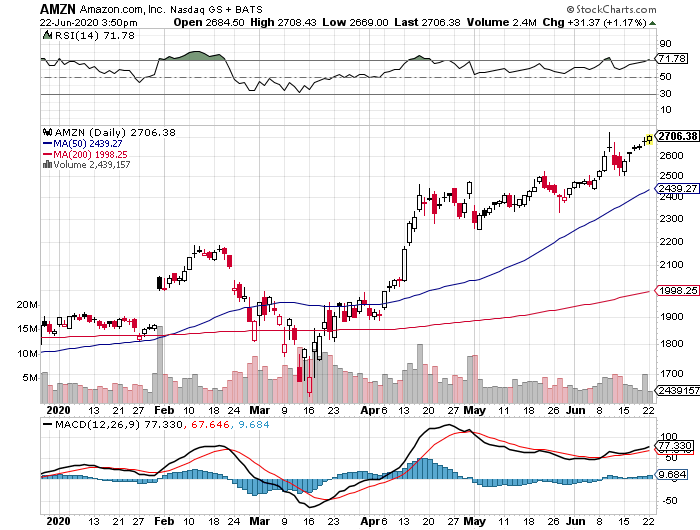
When Amazon shares were at $1,000, I wrote a report calculating that its breakup value was at least $3,000 a share. It looks like Amazon may hit that target before yearend….without the breakup.
Want to know the winners? Try Amazon (AMZN), Chewy (CHWY), and eBay (EBAY).
2. Digital Entertainment
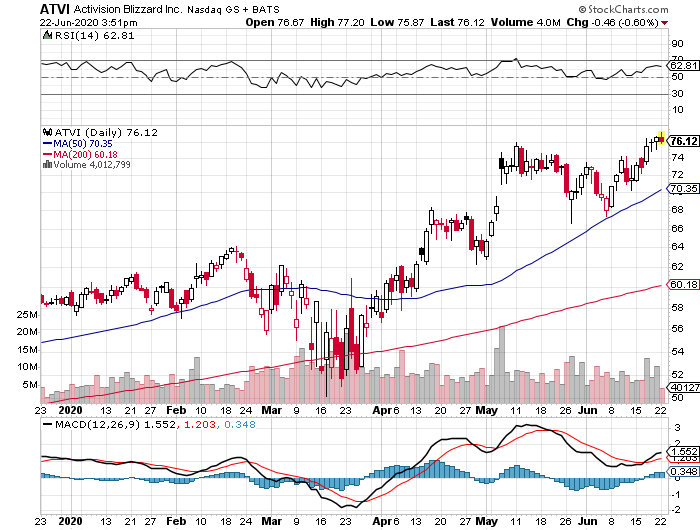
The Covid-19 pandemic has also left more Americans in search of digital, at-home entertainment, a trend that’s delivered a huge push for companies like Activision Blizzard that develop online games. New users, time spend gaming and in-game purchases are only accelerating and spell even more lasting benefit for game developers.
Content names like video streaming site Netflix (NFLX), as well as bandwidth and connectivity companies including Comcast (CMCSA) and T-Mobile (TMUS), are names to focus on.
This increased use of high bandwidth applications is likely to continue post-COVID-19 and has the impact of similarly increasing the demand for bandwidth and connectivity. This increases the value of upstream assets in the infrastructure sectors like fiber-based wireline broadband networks and nascent 5G build-outs.
Names to play the space: Netflix (NFLX), Spotify (SPOT), T-Mobile (TMUS), Activision Blizzard (ATVI).
3. Touchless payments
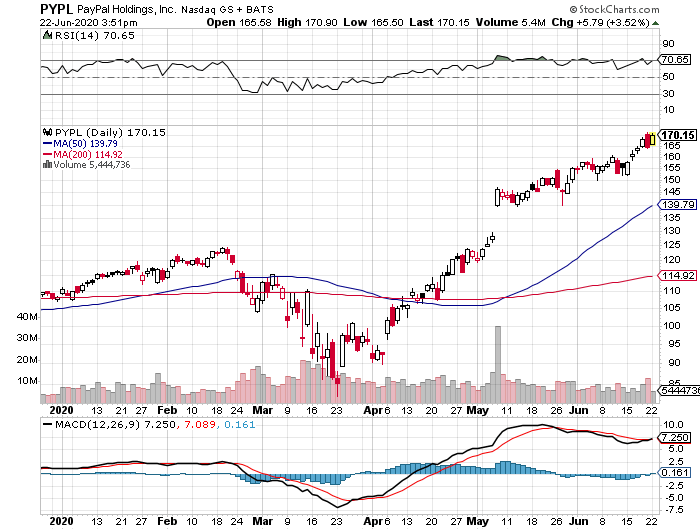
Another trend the stock market still underappreciated is a generational surge in contactless payments, which has recently seen a jump higher amid Covid-19 fears and efforts to minimize physical contact. Companies like Visa (V), Mastercard (MA), and PayPal (PYPL), already integral to the payments world, should be major beneficiaries in the years ahead.
The market assumes that COVID-19 related adoption of digital payments is a near-term benefit for payment service providers, offsetting some of the consumer spending headwinds. However, digitization of payments is part of a multi-year secular growth driver, with COVID-19 as just the latest accelerator.
Names to play the space: Visa (V), PayPal (PYPL), Apple (AAPL), and Mastercard (MA).
4. Telemedicine
Healthcare is one of the most inefficient industries left in the United States. I call it a 19th century industry operating with 21st century technology. While progress has been made, those massive stacks of paper records are finally disappearing, there still is a long way to go.
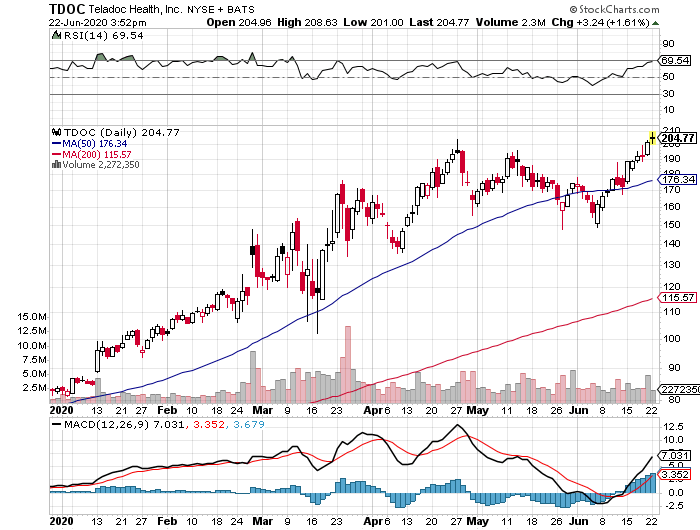
These days, even doctors don’t want to see patients in person, as they may contract the Coronavirus. Far better to see them online, which could address 90% of most patients. Teledoc (TDOC) does exactly that (click here for my full report).
So does Intuitive Surgical (ISRG), maker of DaVinci Surgical Systems, which enables remote operations for a whole host of maladies. Titan Medical (TMDI) is another name to look at here.
Names to play the space: (TDOC), (ISRG), (TMDI).

Global Market Comments
June 19, 2020
Fiat Lux
Featured Trade:
(JUNE 17 BIWEEKLY STRATEGY WEBINAR Q&A),
(SPY), (AAPL), (FXE), (FXA), (BA), (UAL), (AAPL), (MSFT), (BIIB), (PFE), (OXY), (SPCE), (WMT), (CSCO), (TGT)

Below please find subscribers’ Q&A for the June 17 Mad Hedge Fund Trader Global Strategy Webinar broadcast from Silicon Valley, CA with my guest and co-host Bill Davis of the Mad Day Trader. Keep those questions coming!
Q: What is the best way to buy long term LEAPS for unlimited profits?
A: There is no such thing as unlimited profits on LEAPS; they are specifically limited to about 500% or 1,000%. Most people will take that. The answer is to wait for crash day. That’s when you dive into LEAPS, or during very prolonged sell-offs like we had in February or March. That’s where you get the bang per buck. On a capitulation day, you can pick up these things for pennies.
Q: How do you explain that all the cities and states that had major COVID-19 outbreaks and deaths are controlled by Democrats?
A: That’s like asking why you don’t get foot and mouth disease in New York City. The majority of US cities are Democratic, while the rural areas tend towards Republicans and the suburbs that flip back and forth. So, you will always get these big hotspots in cities where the population density is highest and there is a lot of crowding because that’s where the people are. Covid-19 is a disease that relies on within six-foot transmission. You are not going to get these big outbreaks in rural places because there are few people. Horse, cow, and pig diseases are another story. That is one reason the disease has become so politicized by the president.
Q: What is the time horizon for your picks?
A: It’s really a price function rather than a time horizon. Sometimes, a trade works in a day, other times it’s a month. I try to send out a large number of trade alerts because we have new subscribers coming in every day and the first thing they want is a trade alert. Occasionally, I’ll make 10% in a day and I take that immediately.
Q: I’m a new investor; trading in a pandemic is one thing, but what about other risks like volcanic eruptions, major solar flares, or global war? How do I prepare for one of three of these things in the next 25 years?
A: I’m actually worried about all three of those happening this year. If you lived through 1968, everything bad tends to happen in one year, and bad things tend to happen in threes. This is a year where we’re kind of making it up as we go along because there is no precedent. The playbook has been thrown out. Those who always relied on trading stocks and securities predictable ranges got wiped out.
Q: Beijing has quarantined its population again and canceled flights; is this going to cause the Chinese government to ramp up the blame game with the US?
A: Absolutely, the US is the number one Corona incubator in the world by far. We have 120,000 deaths—China had 4,000 deaths with four times the population. Many countries are blaming us for keeping this pandemic alive and spreading it further. But I don’t think foreign relations are a high priority right now with our current government. That said, it is easier for a dictatorship to control an epidemic than a democracy. In China, they were welding people’s doors shut who had the disease.
Q: Do you think taking away the $600 or $1200 stipend for the unemployed is going to crush the chances for many trying to get back to work?
A: It will. A lot of the stimulus measures only delay collapse by a couple of months. The PPP money was only for 2 months; I know a lot of companies are counting on that to stay in business. Some state unemployment benefits run out soon. Either you’re going to have to start forking up $3 trillion every other month, or you’re going to get another sharp downturn in the economy. Cities are bracing themselves for the worst eviction onslaught ever. Mass starvation among the poor is a possibility.
Q: Where do you place stops on vertical spreads?
A: Since vertical spreads don’t lend themselves to technical analysis, you have to draw a line in the sand—for me, it’s 2%. If I lose 2% of my total capital, or 20% on the total position, then I get the heck out of there and go look for another trade. That’s easy for me to do because I know that 90% of the time my next trade is a winner.
Q: Why did you sell your S&P 500 (SPY) July $330/$320 put spread at absolutely the worst moment?
A: The market broke my lower strike price, which is always a benchmark for getting out of a losing trade. When you go out-of-the-money on these spreads, the leverage works against you dramatically. This market isn’t lending itself to any kind of conventional historic analysis. The market went higher than it ever should have based on any kind of indicator you’re using. When the market delivers once in 100 year moves like we had off the March 23 bottom, you are going to be wrong. However, we immediately made the money back by putting on a (SPY) July $335/$340 put spread with a shorter maturity, and a (SPY) July $260-$$270 call spread. If you’re in this business, you’re going to take losses and be made to look like a perfect idiot, like I did twice last week.
Q: Who is getting involved down 10%?
A: I would say you’re getting both institutions and individuals involved down 10%. You keep hearing about $5 trillion in cash on the sidelines, and that’s how it’s coming to work. Plus, we have 13 million new day traders gambling away their stimulus checks.
Q: Why have you not put on a currency trade this year?
A: With the incredible volatility of the stock market, there were always better fish to fry. Currencies haven’t moved that much, and you want stocks that are dropping by 80% in two months and gapping up 200% the next two months. So, in terms of trading opportunities, currencies are number three on that list. Would you rather buy Apple (AAPL) for a 75% move, or the Euro (FXE) for a 6% move? My favorite has been the Aussie (FXA) and it has only gone up 20%.
Q: Do you issue trade alerts on LEAPS?
A: I don’t; most trade alerts are short term trades in the next month or two because we have to generate a large number of them. However, in February, March, and April, we started sending out lists of LEAPS. We sent out about 25 LEAPS recommendations. We did ten for Global Trading Dispatch (BA), (UAL), (DAL), ten for the Mad Hedge Technology Letter (AAPL), (MSFT), and five for the Mad Hedge Biotech & Health Care Letter (BIIB), (PFE). Even if you got just one or two of these, you got a massive impact on your performance because they did go up 500% to 1,000% in 2 months, which is normally the kind of return you see in two years. So, getting people to buy all those LEAPS was probably the greatest call in the 13-year history of this letter. I know subscribers who made many millions of dollars.
Q: I am new to trading; other than placing a trade, what do you recommend I get a handle on in the learning process?
A: We do have two services for sale. We have “Options for the Beginner,” and that I would highly recommend, and I’ll make sure that’s posted in the store. You can’t read or study enough. If you really want to go back to basics, read the 1948 edition of Graham and Dodd, where Warren Buffet got his education actually working for Benjamin Graham in the ’40s.
Q: Will Occidental Petroleum (OXY) go bankrupt?
A: No, they have the strongest balance sheet of any of the oil majors, so I would bet they would hang around for some time. They also have no offshore oil, which is the highest cost source of oil. But it’s going to be a volatile time for a while.
Q: Usually the selling is telling me to go away. With this market, the amount of money on the sidelines, is it going to be a stock picker’s market?
A: Yes, like I said the playbook is out the window. Normally, you get a month’s worth of trading in a month, now you get a month's worth in a day or two. So, we’re on fast forward, Corona is the principal driver of the market and no one knows what it’s going to do. The teens were a great index play. The coming Roaring Twenties will be a stock picker’s market because half of the companies will go out of business, while many will rise tenfold. You want to be in the latter, not the former. And index gets you the wheat AND the chaff.
Q: Will there be another opportunity to buy LEAPS?
A: Yes, especially if we get a second corona wave and it slaps the market down to new lows again. There’s a 50/50 chance of that happening. The rate of Corona cases is now increasing exponentially. We had 4,000 new cases in California yesterday.
Q: How do you see Main Street two years from now? Will the battered middle class ever recover?
They will if they move online. I think main street will be empty in two years. Only the largest companies are surviving because they have the cash reserve to do so. And they seem to be able to get government bailout money far better than the local nail salon or dry cleaner. Again, this was a trend that had been in place for decades but was greatly accelerated by the pandemic. I was in Napa, CA yesterday and half of the storefront shops had gone out of business.
Q: What are your thoughts on the spacecraft company Virgin Galactic (SPCE)?
A: Great for day traders, great for newbies, but not real investment material here. I don’t think the company will ever make money. It was just part of the temporary space had. Better to read about it in the papers and have a laugh than risk your own hard-earned money. Elon Musk’s Space X though is a completely different story.
Q: Which is the better buy now: Walmart (WMT), Costco (CSCO), or Target (TGT)?
A: I’d probably go for Target because they have been the fastest to move to the new online order and curb pickup universe. But Costco is also a great play.
Q: When should I buy Tesla?
A: On the next meltdown or down 30% from here, if and whenever we get that. It’s going to $2,500, then $5,000.
Q: With QE infinity, it doesn’t sound like we’ll get to LEAPS country. Do you agree?
A: No, I wouldn’t agree because at some point, the government might run out of money, the bond market won’t let them borrow anymore, and the money that gets approved doesn’t actually get spent because the works are so gummed up. Plus, Corona is in the driver's seat now. What if we’re wrong and we don’t get 250,000 cases by August, but 500,000 cases? 20 million? There are 100 things that could go wrong and get us back down to lows and only one that can go right and that is a Covid-19 vaccine. We’ve essentially been on nonstop QEs for the last 10 years already and the market has managed many 20% selloffs during that time. If we pursue a Japanese monetary policy, we will get a Japanese result, near-zero growth for 30 years.
Good Luck and Stay Healthy.
John Thomas
CEO & Publisher
The Diary of a Mad Hedge Fund Trader

Mad Hedge Technology Letter
June 15, 2020
Fiat Lux
Featured Trade:
(DON’T TAKE YOUR EYES OFF BIG TECH SHARES),
(GOOGL), (AAPL), (MSFT), (NFLX), (FB), (AMZN), (IBM), (CSCO)
There is literally no possible scenario in a post-second-wave lockdown where the 7 tech stocks of Facebook, Google, Apple, Microsoft, Netflix, Facebook, and Amazon don’t shoot the lights out unless the world ceases to exist.
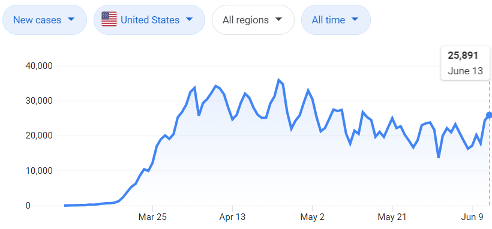
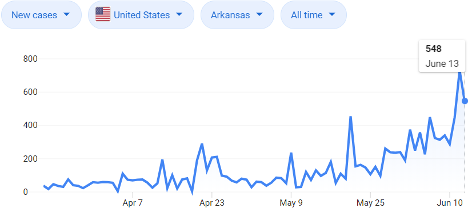
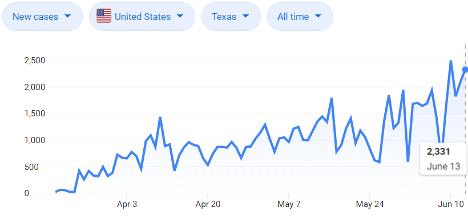
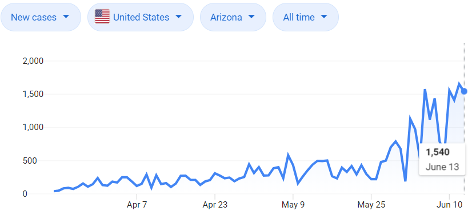
25,891 – that is the number of new coronavirus cases registered in the U.S. on June 13th, 2020 which is about in line with the recent near-term peaks of total daily U.S. coronavirus cases.
Why is this important?
Traders are calculating whether a “second wave” will possibly rear its ugly head to crush the frothy momentum in tech stocks.
That is where we are at now in the tech market.
Tech stocks could possibly ride another magnificent ride up in share appreciation if the reopening of the economy can kick into second gear.
Skeptics are sounding the alarms that this is not even the “second wave” and we still in the latter half of the first wave.
Consensus has it that this could be just a head fake.
The jitters are real with recent dive in tech shares.
The five biggest tech companies burned more than $269 billion in value last Thursday - the worst day for U.S. stocks since March and the 25th worst day in stock market history.
Nasdaq stocks ended the day largely 5% in the red with Microsoft shedding $80 billion in market cap in just one day.
Larger drops were led by IBM who lost 9% and Cisco who lost 8%.
It was a dreadful day at the office, to say the least.
We are teetering on a knife's edge and the tension is running high in the White House with Treasury Secretary Steven Mnuchin already announcing that the U.S. can’t afford another lockdown.
It’s not up to him in the end, it’s about how consumers will assess the confronted health risks.
Tech will undoubtedly be dragged down with the rest on the next lockdown sparing few survivors.
The housing market might actually go down as well as the initial push to the suburbs will dissipate and fresh forbearances will explode higher.
Consumers might not even have the cash to pay for their monthly Apple phone service or internet bill if the worst-case scenario manifests itself.
The health scare has already dented new software purchases by small and medium businesses (SMBs) and tech companies in industries such as travel, retail, and hospitality; online ad spending by the likes of automakers and online travel agencies; and smartphone, automotive and industrial chip purchases.
Small business has held off on reducing their tech software spending too much on the expectation that macro conditions will perform a V-shaped recovery.
Numerous tech firms have cited “demand stabilization,” but it’s not guaranteed to last if we revert to another lockdown.
If a lockdown happens again, it will be another referendum on Fed’s enormous liquidity impulses versus the drop in real earnings or flat out losses to tech business models.
Even with the media’s onslaught of vicious fearmongering campaigns, I do believe this is the time for long-term investors to scale into the best of tech such as Amazon, Apple, Google, Microsoft, Facebook, Netflix.
If you thought these 7 companies had anti-trust issues before, then look away.
We could gradually head into an economy where up to 40% of the public markets comprise of only 7 tech stocks which is at a mind-boggling 25% now.
Never waste a good crisis – tech is following through like no other sector!
Bonds don’t make money anymore and hiding out now means putting your life savings into these 7 premium tech stocks.
In the short-term, this is a good opportunity for a tactical bullish tech trade.
Global Market Comments
June 11, 2020
Fiat Lux
Featured Trade:
(WHY TECHNICAL ANALYSIS DOESN’T WORK)
(FB), (AAPL), (AMZN), (GOOG), (MSFT), (VIX)
(TESTIMONIAL)


Santa Claus came early this year.
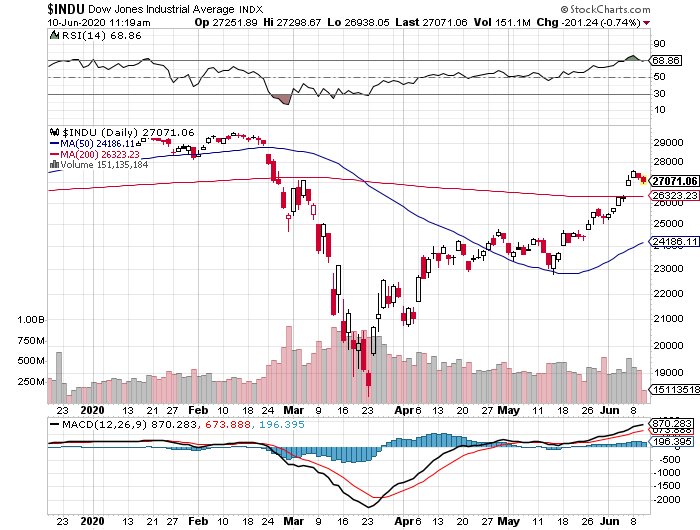
We have now rocketed all the back from -37% to a feeble 0% return for the Dow Average for 2018. By comparison, the Mad Hedge Fund Trader is up a nosebleed 8.5% during the same period.
If you had taken Cunard’s round-the-world cruise four months ago, as I recommended, you would be landing in New York about now, wondering what the big deal was. Indexes are nearly unchanged since you departed, with the Dow only 5.50% short of an all-time high.
This truly has been the Teflon market. Nothing will stick to it. Not, plague, not depression, not mass bankruptcies, not the worst economic data in history.
Go figure.
It makes you want to throw your hands up in despair and your empty beer can at the TV set. All this work and I’m delivered the perfectly wrong conclusions?
Let me point out a few harsh lessons learned from this most recent meltdown and the rip-your-face-off rally that followed.
Remember all those market gurus claiming stocks would rise every day for the rest of the year? They were wrong.
This is why almost every Trade Alert I shot out for the past two months has been from the “RISK ON” side, but only after cataclysmic market selloffs.
We have just moved from a “Buy in November” to a “Sell in May” posture.
The next six months are ones of historical seasonal market weakness. For the misty origins of this trend, read “If You Sell in May, What to Do in April?” On top of that, we have the uncertainty of the presidential election to deal with.
We go into this with big tech leaders, including Facebook (FB), Apple (AAPL), Amazon (AMZN), Google (GOOG), and Microsoft (MSFT), all at or close to all-time highs.
The other lesson learned this year was the utter uselessness of technical analyses. Usually, these guys are right only 50% of the time. This year, they missed the boat entirely. After perfectly buying the last top, they begged you to dump shares at the bottom.
When the S&P 500 (SPY) was meandering in a narrow nine-point range, and the Volatility Index (VIX) hugged the $11-$15 neighborhood, they said this would continue for the rest of the year.
It didn’t.
When the market finally broke down in February, cutting through imaginary support levels like a hot knife through butter ($26,000? $25,000? $24,500?), they said the market would plunge to $24,000, and possibly as low as $22,000.
It didn’t do that either.
If you believed their hogwash, you lost your shirt. The market just kept going, and going, and going down to $18,000.
This is why technical analysis is utterly useless as an investment strategy. How many hedge funds use a pure technical strategy? Absolutely none, as it doesn’t make any money on a stand-alone basis.
At best, it is just one of 100 tools you need to trade the market effectively. The shorter the time frame, the more accurate it becomes.
On an intraday basis, technical analysis is actually quite useful. But I doubt a few of you engage in this hopeless persuasion.
This is why I advise portfolio managers and financial advisors to use technical analysis as a means of timing order executions, and nothing more.
Most professionals agree with me.
Technical analysis derives from humans’ preference for looking at pictures instead of engaging in abstract mental processes. A picture is worth 1,000 words, and probably a lot more.
This is why technical analysis appeals to so many young people entering the market for the first time. Buy a book for $5 on Amazon and you can become a Master of the Universe.
Who can resist that?
The problem is that high-frequency traders also bought that same book from Amazon a long time ago and have designed algorithms to frustrate every move of the technical analyst.
Sorry to be the buzzkill, but that is my take on technical analysis.
Hope you enjoyed your cruise.

Global Market Comments
June 9, 2020
Fiat Lux
Featured Trade:
(HOW TO EXECUTE A VERTICAL BULL CALL SPREAD)
(AAPL)
(THE NEW CODER BOOM)
Global Market Comments
June 5, 2020
Fiat Lux
Featured Trade:
(JUNE 3 BIWEEKLY STRATEGY WEBINAR Q&A),
(FB), (M), (UAL), (LVS) , (WYNN), (MS), (SPX), (TBT), (TLT), (AAPL), (FB), (MSFT), (SDS), (SPX), (AMZN) (LEN), (KBI), (PHM), (TSLA)