Mad Hedge Bitcoin Letter
March 22, 2022
Fiat Lux
Featured Trade:
(GOLDMAN INCHES INTO CRYPTO)
(BTC), (GS), (OTC)


Mad Hedge Bitcoin Letter
March 22, 2022
Fiat Lux
Featured Trade:
(GOLDMAN INCHES INTO CRYPTO)
(BTC), (GS), (OTC)
When it rains, it pours.
That will be the transformational effect if institutional money finally comes on board the crypto train.
They are still poking around the edges and sniffing it to see if it is something they really want to get into.
Don’t forget that many of these institutions are beholden by a rigid set of regulations that they must adhere to and joining the wild west of crypto is for some, a step too far.
There is no doubt in my mind that the industry of money is barreling towards a digitized and decentralized version of it and many of these institutions don’t want to be left behind.
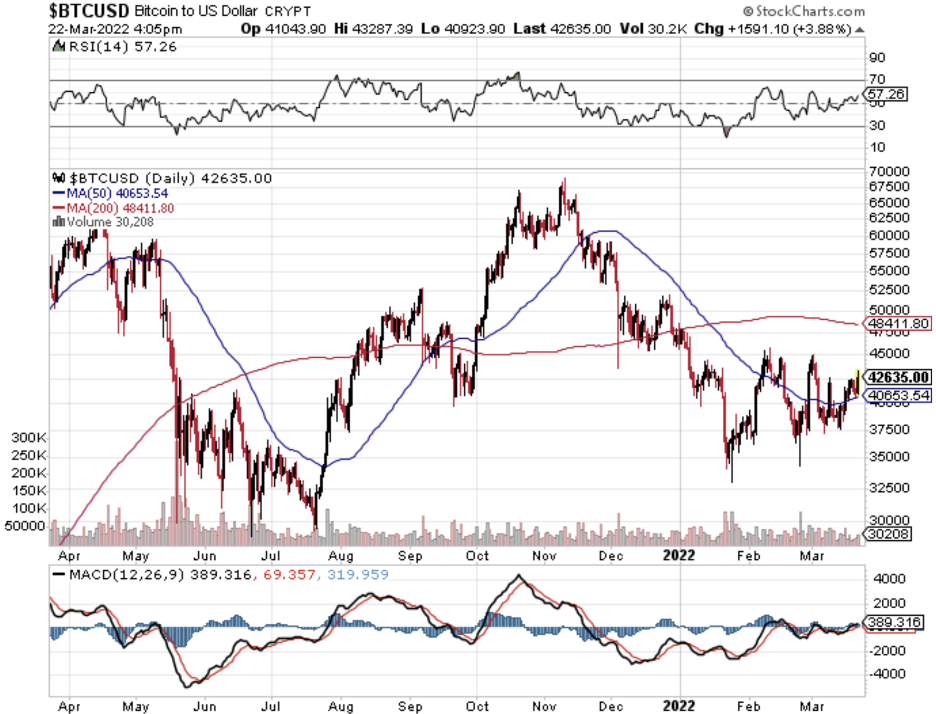
It’s bad enough they didn’t participate in the meteoric rise of Bitcoin (BTC) from almost zero to above $60,000 almost as if a portfolio manager missed a 10-year bull market.
But inroads are being made nonetheless and one of the preeminent investment banks, Goldman Sachs, took a giant leap forward toward the possible wide adoption of bitcoin among institutional investors, such as hedge and pension funds.
A step that will comfort some big investors, many of whom are still on the fence to invest in cryptocurrencies and in particular in bitcoin, the first digital currency in terms of market share.
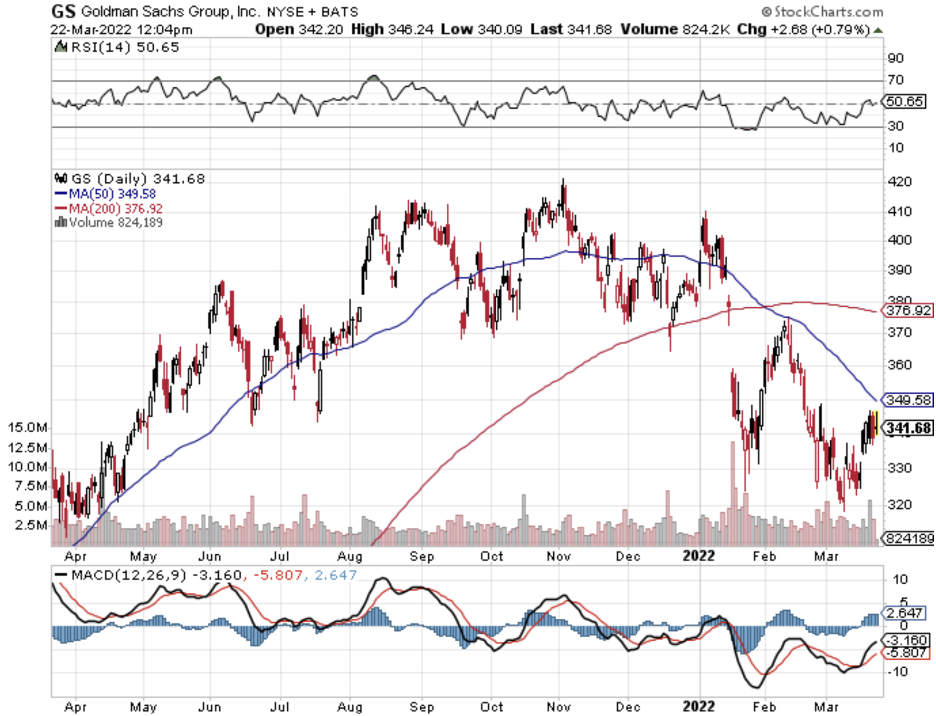
Goldman Sachs (GS) executed its first over-the-counter (OTC) crypto options trade.
The firm traded a bitcoin-linked instrument called a non-deliverable bitcoin option (NDO), which is a derivative tied to bitcoin’s price that pays out in cash.
Options are used by crypto investors to hedge risks or boost yields, and over-the-counter transactions are larger trades negotiated privately.
This transaction gets GS closer to the crypto industry with regards to having skin in the game.
At the very least, they recognize there is something there and a major revenue opportunity if they do this the right way.
This marks the first OTC crypto transaction by a major bank in the U.S., and as GS continues expanding its cryptocurrency offerings, demonstrating the continued maturation and adoption of digital assets by banking institutions.
Is Bitcoin legit?
This move is an important step in the development of the crypto market for large investors because OTCs mean that Goldman Sachs will act as a principal in the transaction.
Goldman Sachs' involvement also sends a signal to mainstream investors that cryptocurrency-related assets have matured.
We are pleased to continue to strengthen our relationship with Goldman and expect the transaction to open the door for other banks considering OTC as a conduit for trading digital assets.
The concern that offering financial services related to cryptocurrencies might increase that burden of regulation is substantial.
But the change is also a cultural switch.
Legacy banks cringe that there is still too much uncertainty surrounding the regulation of the crypto industry.
However, there have been notable changes in recent months.
Famous investors like Ray Dalio and Bill Gross have thrown their support behind cryptocurrencies, a sign that the lines are moving at hedge funds, which bodes well for bitcoin.
GS is also offering exchange-listed options and futures trading in bitcoin and ethereum.
This is the first step of a bigger pivot to crypto as GS and other banks plan to build businesses out of it.
It is yet to be determined whether they push aggressively into it, but my hunch is that they move incrementally reflecting the extreme uncertainty of the rules of the road.
Intent is one thing, and it is true that development will take time to materialize, but a development of digital currencies doesn’t take place in one day.
Either way, this is another victory in the long-term prospects of Bitcoin and crypto.
Mad Hedge Bitcoin Letter
March 17, 2022
Fiat Lux
Featured Trade:
(BITCOIN SET UP WELL FOR THE LONG TERM)
(BTC), (VASP)


Whether you are in it for the money or in it for the tech, many have earmarked asset appreciation as a pillar of their current and future growth.
Step one is just owning crypto.
Speaking for many Americans on the grind and eking out an existence, you guessed it right, many are in the same boat.
If faced with a crisis, financially many would say they are royally screwed.
Bank rates aren’t up to snuff, and it just seems the government is giving the people a raw deal constantly.
Then look across the Atlantic and the climate doesn’t look all that fantastic either.
I could easily argue that the latest military action in the east of Europe has triggered alarm bells not just here at home but in rich and poor countries around the world as well.
Foreign investors look at the confiscation of US dollar reserves and freezing of assets in Europe and ask themselves, am I next?
I understand that the Western government feels the urge to go after illicit money, but then what about the rest of the foreign assets that aren’t necessarily all that clean either, do they get wiped out as well?
The reaction to foreign assets and their protection could trigger a massive pivot to cryptocurrency and bitcoin because unprecedented action by fiscal authorities could have a long-lasting impact on foreign capital and its direction.
We already have a young generation who is holding hope that crypto can be a lifeline to get out of this endless loop of personal financial tumult.
But crypto is not secure. We all know this. For investors with a budget already, it’s difficult to justify investing into a speculative asset class that failed recent acid tests.
I don’t blame marginal investors if they believe cryptocurrency is still very scammy and hasn’t matured enough to graduate from being priced with a low-quality growth stock.
What’s the solution?
How about donating plasma? Just kidding. But on a serious note, the macro events abroad signal that cryptocurrency absolutely has a role in many people’s lives.
The quality of global governance has gone from bad to worse.
The consequence is widespread panic and chaos that are spilling over into NATO borders.
Granted, refugees don’t have a lot of money to invest right now, but I could easily see young Russians and Ukrainians avoiding fiat currency altogether and preferring to go with crypto once they start earning fiat abroad.
Even fiat can go to zero which each one has over time.
Ask the Romans, their fiat went to zero as well.
Then at a structural level, crypto is starting to establish itself not only in America but in other outposts. For instance when cryptocurrency exchange Binance just announced that it had been granted a license to operate in Dubai, United Arab Emirates. The company’s presence in the Middle East has been building up lately, with a crypto service provider license in another Gulf market, Bahrain, coming in earlier this week.
Under the Dubai virtual asset provider (VASP) license, Binance will be allowed to set up an office in the emirate and provide digital asset exchange services to pre-qualified investors and financial firms under the newly adopted regulatory guidelines.
Both Bahrain and UAE embrace an innovation-friendly approach and compete for the status of the region’s most crypto-supportive jurisdiction.
As much as it’s painful to see one’s local currency blow up in one fell swoop like the Russian Ruble and all the other post-Soviet currencies, the people of these countries must question if they really want to go on the same ride with other Western countries’ fiat when they are debasing the hell out of their currencies every year.
Russians can’t even use their bank cards because MasterCard and Visa cut off service. Will they ever trust these services again?
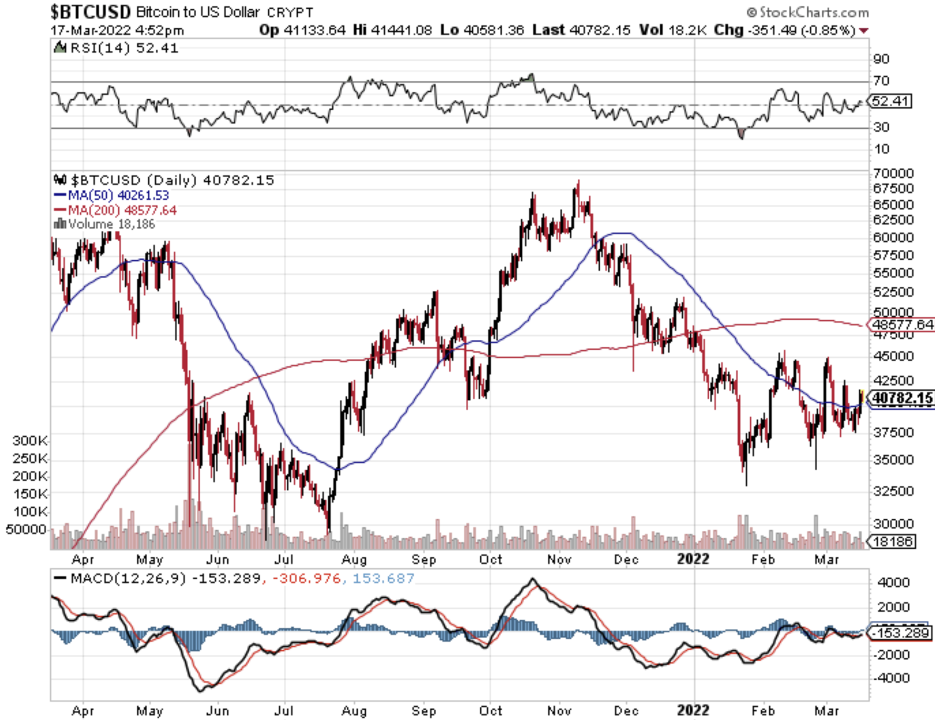
Over 25% of the current US dollars in existence were printed in the past 2 years and that isn’t necessarily the best vote of confidence for a Russian whose savings dissipated into thin air.
And who wants Chinese yuan?
Not me and the next guy shouldn’t want it either.
Mad Hedge Bitcoin Letter
March 15, 2022
Fiat Lux
Featured Trade:
(CRYPTO GETS A PASS FOR NOW)
(BTC), (MICA)

Europe has to be considered the King of regulation. They boast the highest tax regimes of the developed world, and I am not referring to loophole countries like Cyprus.
Why does that matter?
The EU went after and still goes after big tech with a vengeance.
Alphabet and Facebook have been on the receiving ends of many billions of dollars in fines and more will head their way in the future.
Tech fines don’t matter in terms of the health of crypto but don’t think that the Europeans are any different when they set their sights on digital currency.
If they see it, they will try to tax it to oblivion.
Just look at Belgium which charges a robust 11.3% in annual property taxes and Spain which registers right behind them at 8%.
The Europeans don’t discriminate and love to tax everything.
So it wasn’t out of the ordinary that The Markets in Crypto Assets (MiCA) legislation included a clause pledging to make crypto assets traded or issued within the bloc ‘subject to minimum environmental sustainability standards’.
Even if this wasn’t a direct tax on crypto, the design of the legislation would amount to a de facto ban on crypto assets because there is nothing environmentally sustainable about mining crypto.
In fact, mining crypto is terrible for the environment and requires large sums of energy to produce digital coins.
That energy is usually dirty energy in the form of fossil fuels.
An element of this has to do with spiking energy costs which has been induced by Russia’s Vladimir Putin’s war on Ukraine.
Many countries have experienced a doubling of energy prices and for the supply left over, do we as a society want to allocate energy to crypto mining when apartment is going dark?
Energy and inflation have become the modern-day battlefield for politicians duking it out and dragging crypto into this game is overwhelmingly negative for crypto.
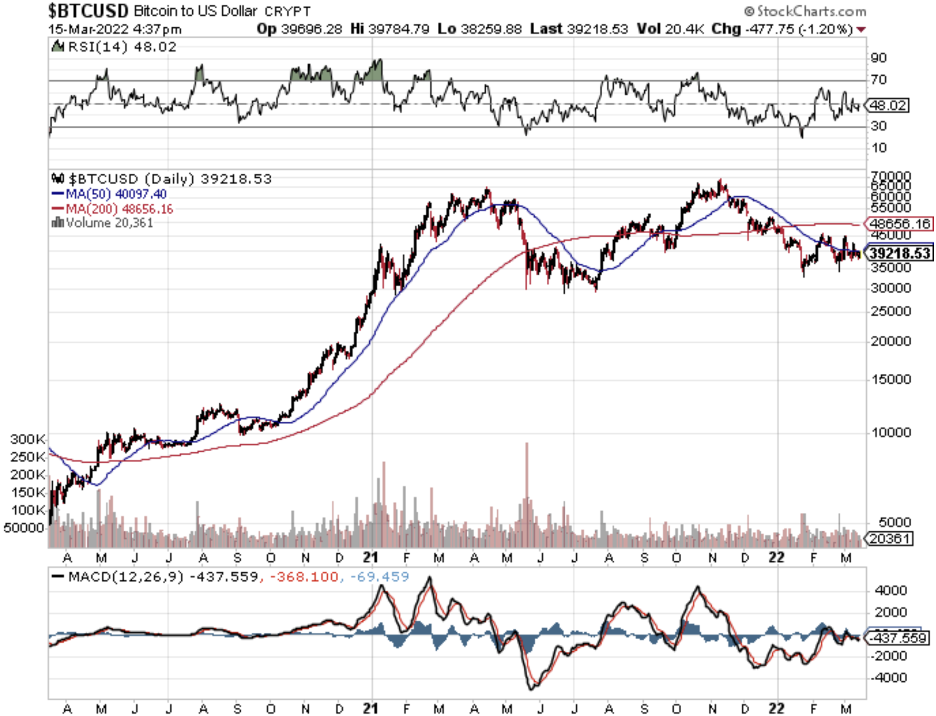
Crypto has experienced poor price action lately and this adds fuel to the fire.
Banning crypto in Europe would be cataclysmic to the currency after China slammed the door shut on it.
The EU’s Economic and Monetary Affairs Committee voted on a final draft of the Markets in Crypto-assets (MiCA) which included a clause pledging to make crypto assets traded or issued within the bloc “subject to minimum environmental sustainability standards.” A final tally of the committee’s voting showed the proposed clause was defeated with 23 votes in favor, 30 against and six abstentions.
Demand for Bitcoin (BTC) and other tokens has pushed up their carbon footprint significantly in the last year. Data from the Cambridge Centre for Alternative Finance put Bitcoin’s estimated power consumption at an annual rate of 138 terawatt-hours in early 2022, more than the size of a country like Norway.
Miners, much like car drivers, aren’t interested in unreliable renewable energy.
Intermittent supply of energy would cripple a crypto miners’ business much like if a truck driver would rely on sparse electric refill stations to drive cross country.
Although many have boiled down this decision to a landmark victory, I don’t believe this is the end of the regulation circus that is Europe.
If exorbitant energy prices are here to stay, Europe might not have any other choice but to go after crypto for another source of revenue.
And if crypto mining is taxed using sustainability criteria, it will cause many miners to shut down and the crypto industry itself will be shut down because they won’t pass the clean energy criteria needed to operate.
High energy prices have many unintended consequences are crypto could be another martyr to it.
Let’s hope the crypto regulation is pushed out into the long term so the industry has time to develop its foundation and obviously that won’t be possible if the mining business gets killed.
Can the Europeans singlehandedly crash the crypto industry?
No, but it doesn’t help the adoption rate for an emerging industry making it that much harder to mature.
America’s pro-business climate has been a godsend to multinational corporations, and it will be the same way for crypto if it is allowed to develop in America.
Mad Hedge Bitcoin Letter
March 10, 2022
Fiat Lux
Featured Trade:
(WASHINGTON GETS SERIOUS ABOUT CRYPTO)
(BTC), (FB)

U.S. President Joe Biden signing a crypto executive order is more bark than bite.
It doesn’t mean that anything really will happen, especially in the short term.
Optics are quite important for the current American administration, and I believe this is another instance.
Throw the crypto fanatics a bone and hype it up like a transformational moment when it’s not.
If you live in a world of hard outcomes, then this isn’t one of them.
Granted, it’s a step in the right direction, but no meaningful legislation has been enacted yet and I highly doubt that anything concrete gets done before the next administration.
I won’t get into the business of hyping up this announcement of “establishing a framework” for the digital gold because it echoes the direction they were supposed to go with big tech.
Big tech was supposed to get regulated to the utmost, but nothing ever came of it.
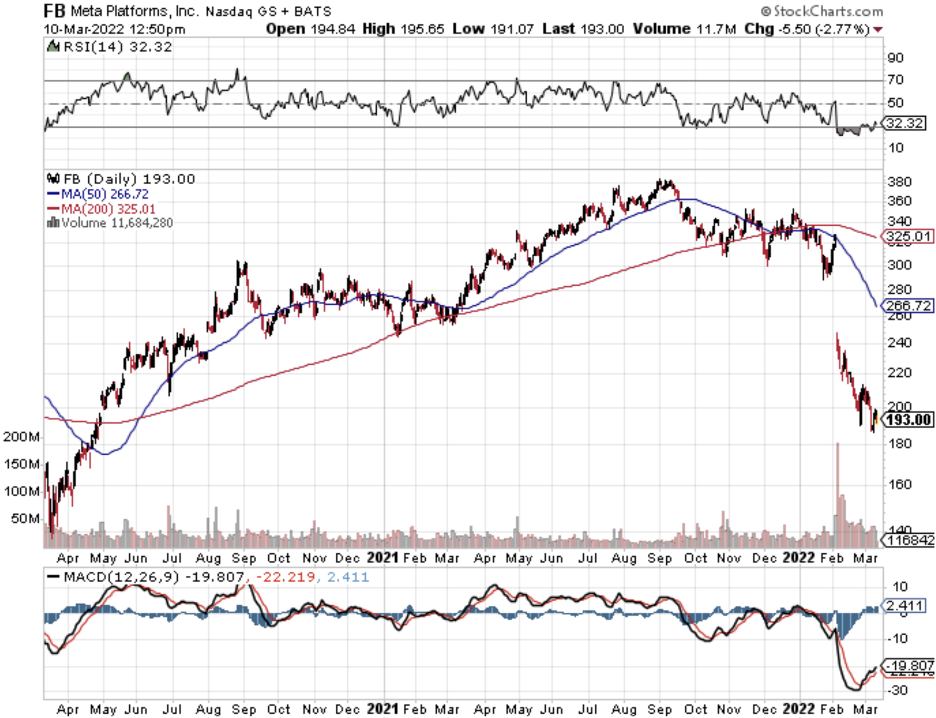
The only tech firm that blew up was Meta or Facebook (FB), but that was more about self-inflicted wounds than anything else.
Big tech is largely unscathed from the historical behavior, and nothing has changed in terms of the handling of personal data and its integrity.
Turning a blind eye than rather dealing with issues has been sort of the consensus for anything really controversial with big business.
I don’t believe the administration will lift a finger and plan to treat crypto as politicking even to please optics.
This will create a situation where they can straddle positions on both sides so they can claim innocence if something goes wrong with crypto or take the credit if crypto develops.
The reports will dish up buzz words like “historic” and “unprecedented.”
The order was finally signed Wednesday. It calls on federal agencies to take a unified approach to regulation and oversight of digital assets, according to a White House fact sheet.
A unified approach could also mean that nobody does anything together so we will need to see more substance out of Washington.
The Biden administration is calling on the Treasury to assess and develop policy recommendations on crypto.
Even if recommendations can be decided upon, it doesn’t mean that it will be net positive for Bitcoin’s price.
Last month, U.S. officials seized $3.6 billion worth of bitcoin — their biggest seizure of cryptocurrencies ever — related to the 2016 hack of crypto exchange Bitfinex.
Following Russia’s invasion of Ukraine, authorities are now also concerned about the possible use of crypto in helping sanctioned Russian individuals and companies evade the restrictions.
There is illegal activity that the government wants to stamp out and writing the rules makes it easier to do that.
The Biden administration also wants to explore a digital version of the dollar which is copying the Chinese playbook.
Much of the policy is strategizing relative to what China and Russia are doing and he fell short of saying that the US will create a digital dollar.
Again, it’s more of the optics of saying the government need “urgency” on research and development of a potential digital dollar which doesn’t really mean anything.
The Federal Reserve last year began work on exploring the potential issuance of a digital dollar. The central bank released a long-awaited report detailing the pros and cons of such virtual money but didn’t take a position yet on whether it thinks the U.S. should issue one.
These announcements are a far cry from real policy moves.
It’s great that more resources will be thrown at the asset class but research and urgency don’t mean much in terms of hard victories.
Short-term, this Eastern European crisis has been a massive shot across the bow for Bitcoin fanatics because it has proven that during a possible nuclear war, nobody will buy Bitcoin.
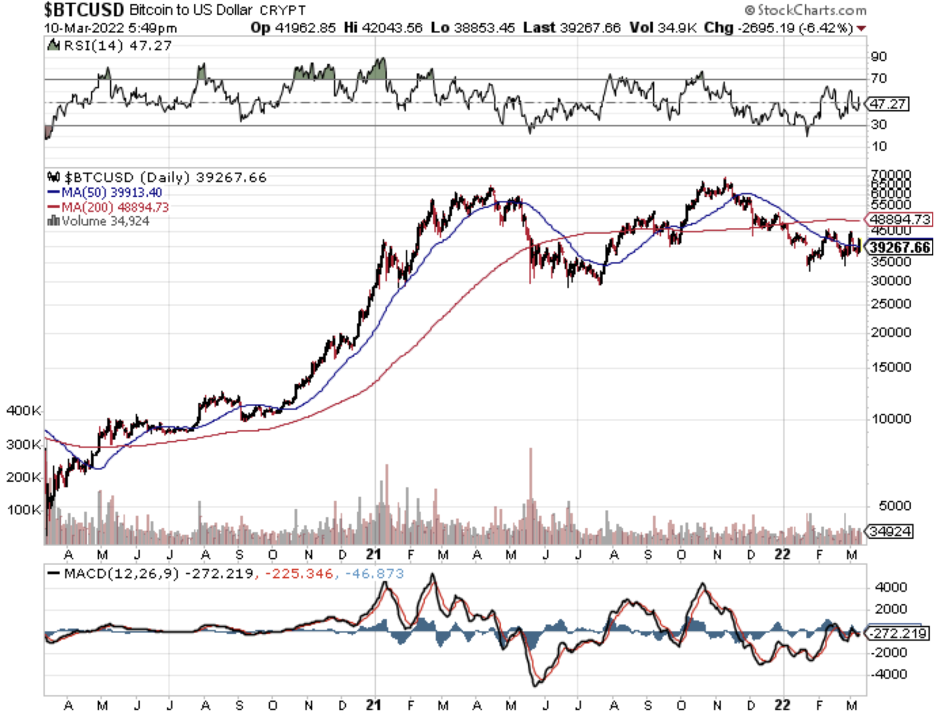
After the dead cat bounce, there was another draconian sell-off this morning in Bitcoin with the asset down 7%, again, diving below $40,000.
The bad price action was created by the 7.9% CPI print and Bitcoin was supposed to be an inflation hedge, but the price action suggests it performs poorly as an inflation hedge.
The jury is out but Bitcoin has failed some major tests this year and it will be a hard slog for the rest of the year.
Sell the rallies until the backdrop and variables change for the better.
Mad Hedge Bitcoin Letter
March 8, 2022
Fiat Lux
Featured Trade:
(STAGFLATION COMES TO THE FORE)
(BTC)
It’s been well documented that we are in the midst of worsening inflation pressures and damaging growth prospects.
This is what many call a stagflationary shock, essentially making things worse on all economic fronts at once.
I do believe if we don’t get a decisive change of events in terms of the macro picture in the medium term, this could be negative for the prospects of Bitcoin appreciation for the rest of 2022.
Bitcoin performs best when inflation is moderate yet rising and growth is humming along.
The expanding pie means there is more capital to allocate towards more speculative investments which this European war has proven Bitcoin is.
When the threat of nuclear war presents itself, investors flee speculative assets like growth tech and reign back risk to choose assets such as gold, US dollar, and other hard commodities.
It’s really a shame because we were right on course for a splendid pandemic recovery and all major Western economies were experiencing boomflation — strong growth with high inflation.
Unfortunately, removing the growth part of the equation out of the mix, will the incremental investor want to dive into Bitcoin or allocate their assets to a different sector?
Most likely no.
Unless Bitcoin strengthens itself and presents itself as more appetizing during cataclysmic times, its hard to see investors betting the ranch in Bitcoin right now.
Much of the consensus before the military conflict was that investors were greenlighting 5% of their portfolio into crypto and other alternative investments.
A stagflation scenario would put a serious wrench in that consensus.
The near-term winner has certainly been hard commodities like precious metals evident by nickels' 90% spike in one day.
Even more problematic, stagflation isn’t the kind of economic disruption that can be fixed with a cheeky use of fiscal or monetary policy.
It's all pain with no upside, and what investor likes that?
The invasion sent commodity prices surging and global stock markets and bond yields plunging.
The median American in this environment is going to be more worried about paying more for gas or their spaghetti than investing in Bitcoin.
But financial market prices don't tell the full story. They remain highly volatile, as geopolitics has scared a lot of investors from the markets altogether which is another worry for not only Bitcoin but which is why we are seeing massive selloffs in the overall market.
In times of absolute strain, there is no incremental investor demand for speculative assets and people with money are more likely to buy a 5-bedroom house to bunker down and ride this thing out.
Higher energy prices — already evident in commodity markets — directly feed into higher inflation, but the risks are more sprawling and hard-to-calculate than that implies.
The concept of higher energy prices also will cause the costs of mining Bitcoin to skyrocket because mining is extremely energy-intensive.
This energy spike will be terrible for Bitcoin mining companies who are reliant on the world’s energy markets for their source of energy.
They have no way to circumvent this as their biggest input is energy.
Let’s not assume everyone stops mining, but let’s say the largest miners who have dedicated warehouses full of miners stop mining.
This would cause the network to come to a screeching halt, no blocks would be found until the block difficulty readjusts.
This happens every 2 weeks. Bitcoin’s mining algorithm is about guessing random numbers and hoping you get lucky. The mining difficulty indicates the threshold of a valid magic number. Any number less than the given difficulty is a valid block. Any number larger than the given difficulty is considered an invalid block by Bitcoin’s mining algorithm.
If all large miners were to stop mining, the mining difficulty would decrease (the magic number that determines block validity would actually increase), which means miners can now find a number larger than when large miners were mining and have the block be valid.
Essentially, this is negative for the development of Bitcoin because we would start to see the Bitcoin infrastructure erode.
This is at a time when investors are already questioning the use case of it during the threat of nuclear war or a 3rd world war.
Bitcoin needs all the help it can get and stagflation and miners dropping like flies triggering a collapse of infrastructure won’t help convince the incremental investors that Bitcoin is the place to put real money.
Sell the rallies if we get one.