• support@madhedgefundtrader.com
  • Member Login
Mad Hedge Fund Trader
  • Home
  • About
  • Store
  • Luncheons
  • Testimonials
  • Contact Us
  • Click to open the search input field Click to open the search input field Search
  • Menu Menu

Tag Archive for: (ETH)

Mad Hedge Fund Trader

The Strong Breadth of Crypto

Bitcoin Letter

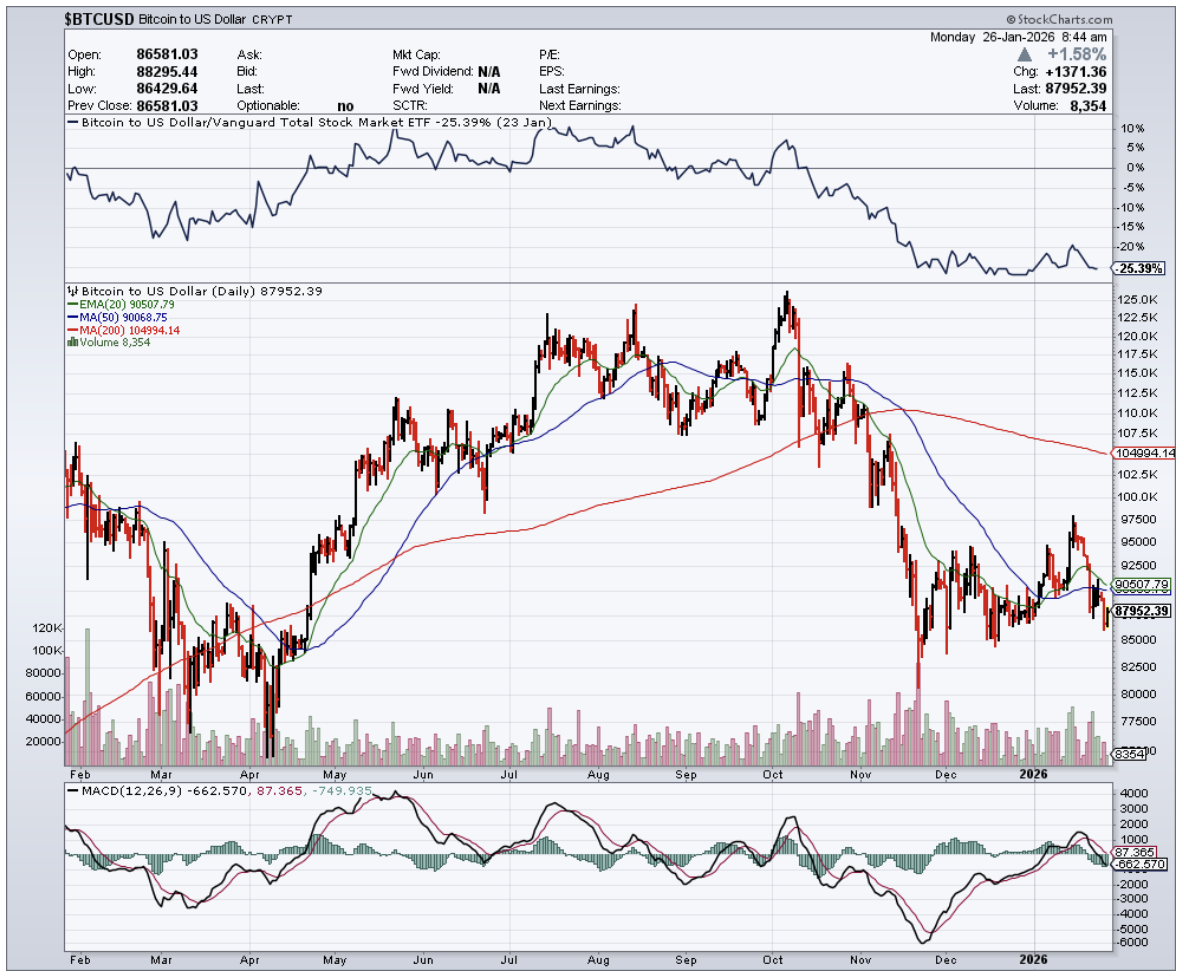
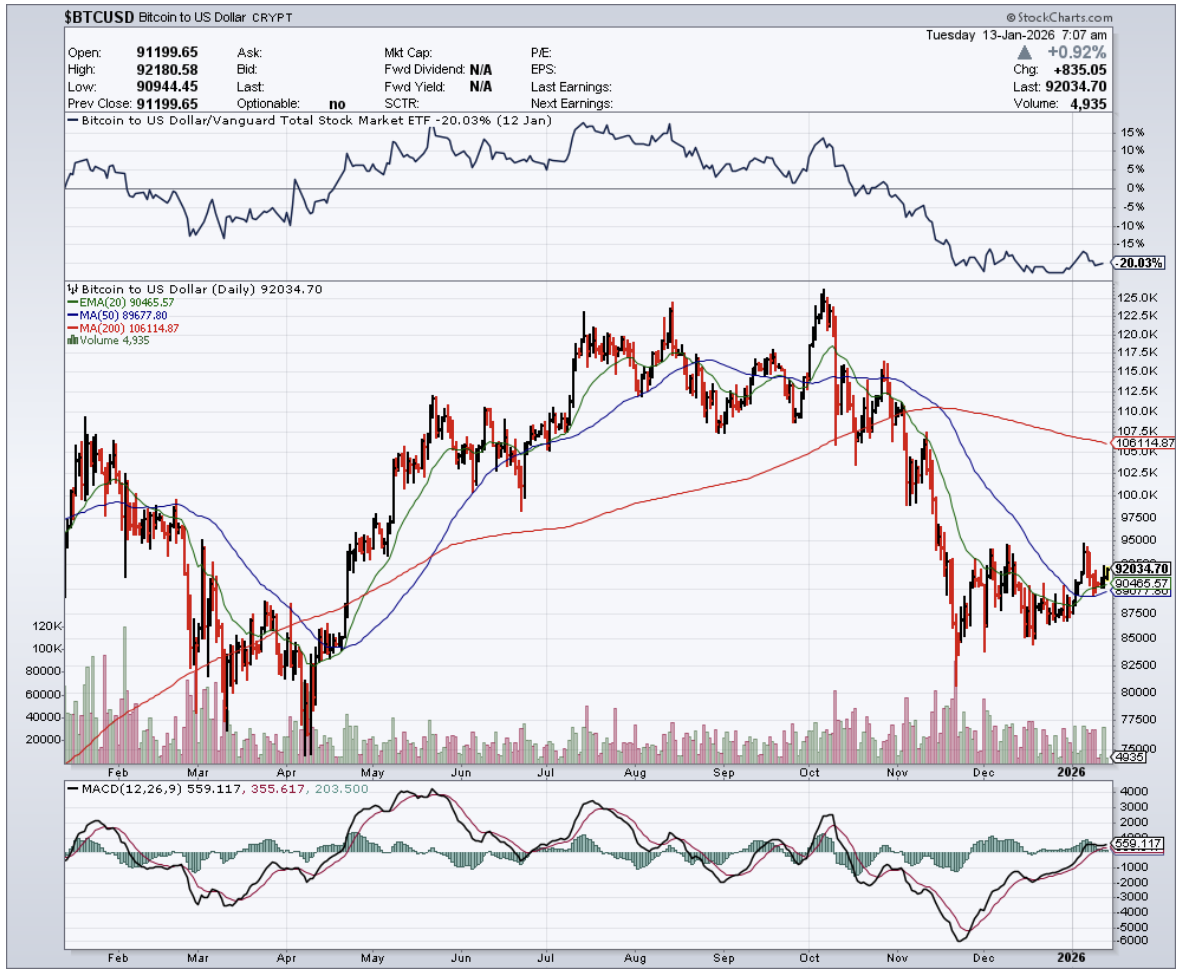
Periods of weakness in Bitcoin price action often reflect positioning and profit-taking rather than a breakdown in the asset’s underlying structure.

Bitcoin remains a volatile asset by design, and retracements have historically occurred even during sustained growth phases. Sharp pullbacks, while uncomfortable, have repeatedly functioned as resets rather than trend reversals.

From a structural perspective, Bitcoin’s price behavior continues to reflect cyclical volatility rather than instability.

Corrections are a feature, not a flaw.

Bitcoin does not move in a straight line, and expectations that it should do so tend to form near local extremes rather than durable inflection points.

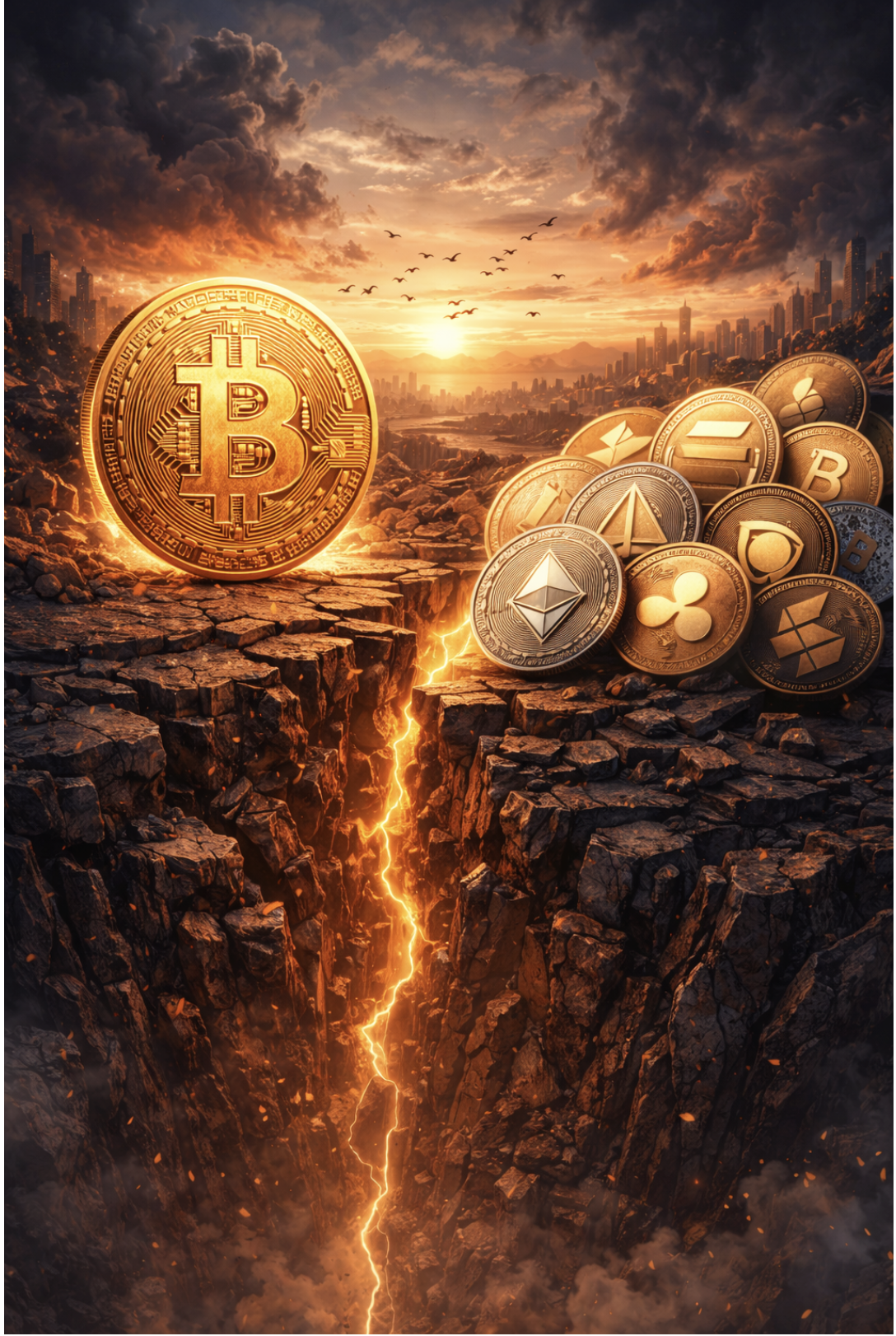
What has been more notable during periods of Bitcoin consolidation is the behavior of the broader digital asset market.

Even when Bitcoin has struggled to make near-term progress, capital rotation into alternative crypto assets has often remained active, signaling broader participation rather than capital flight.

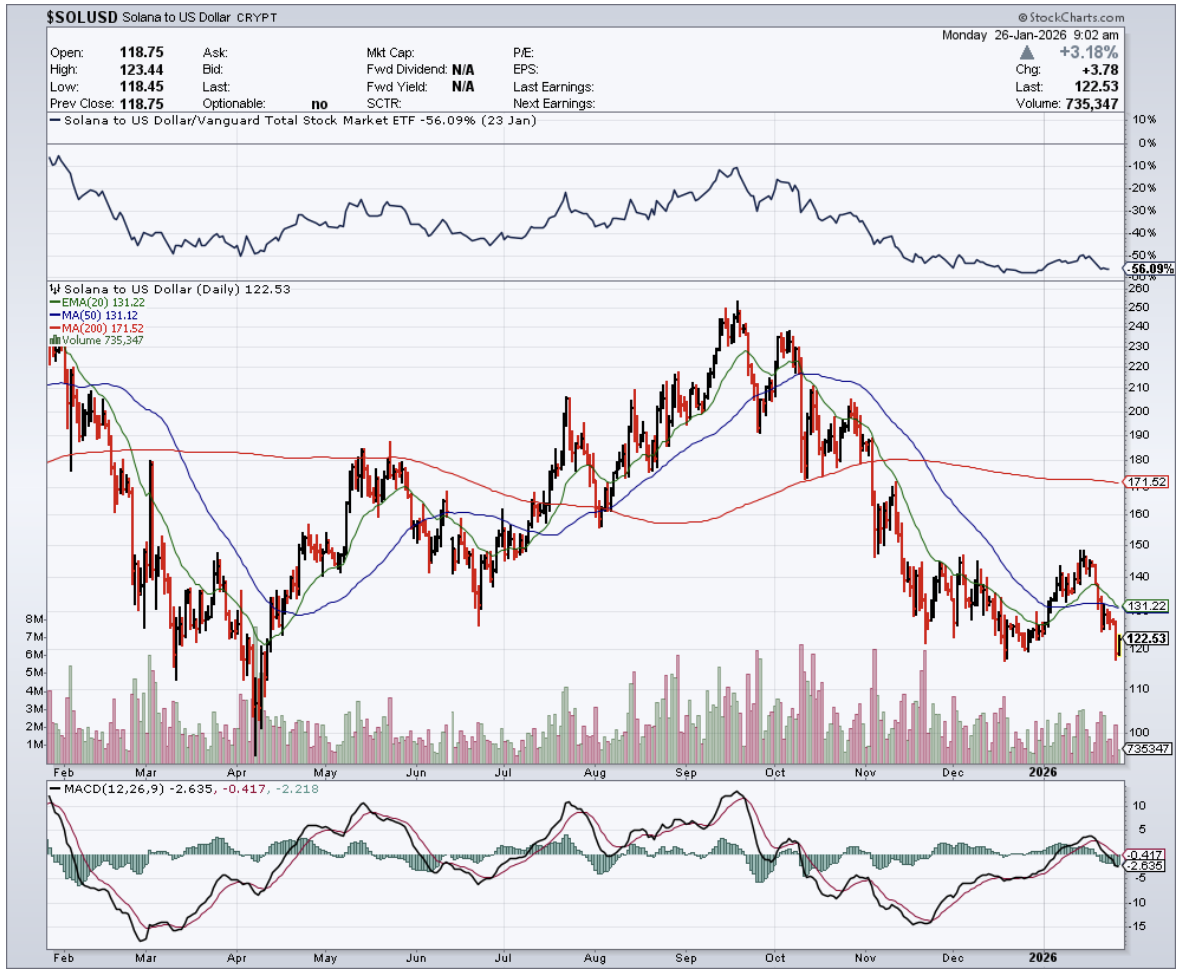
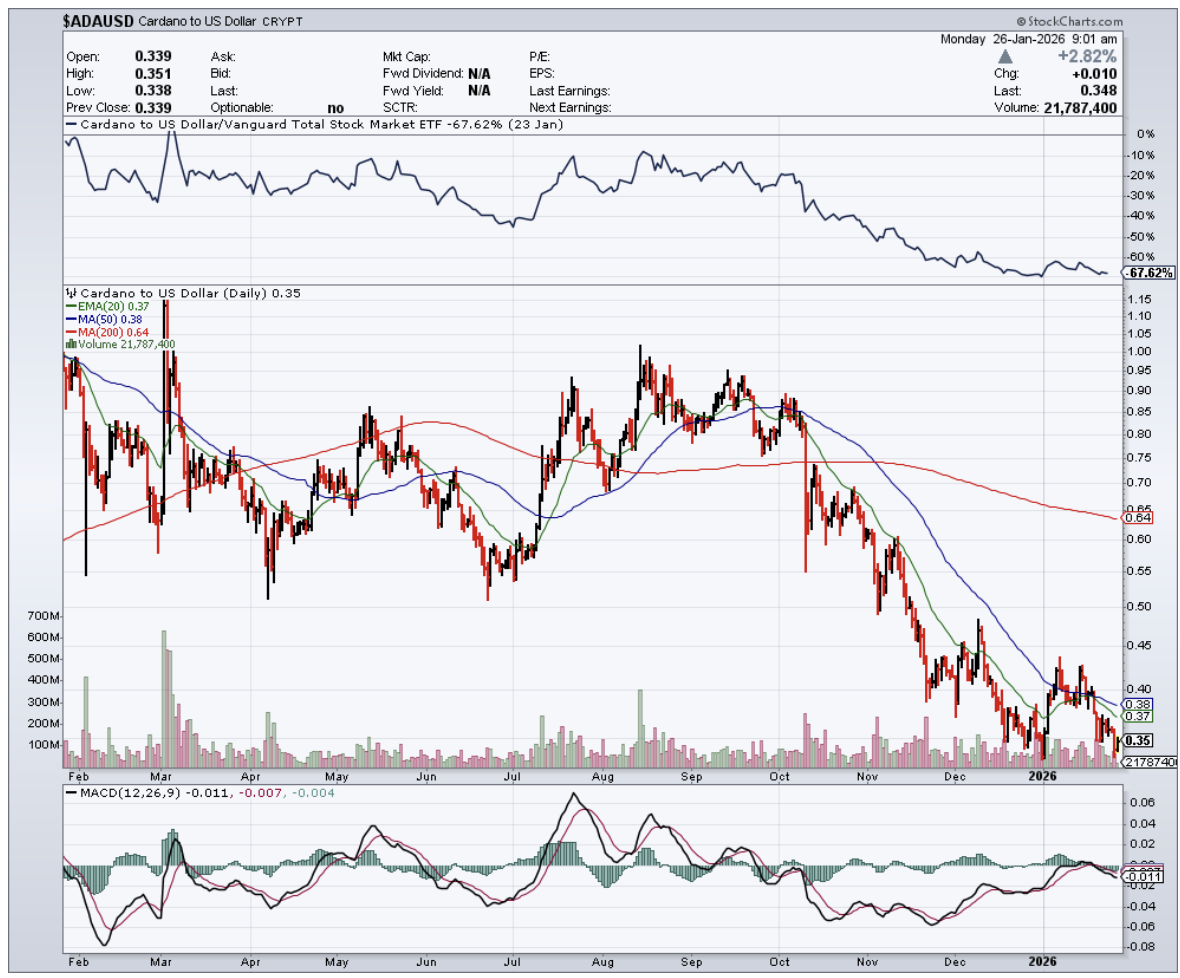
Assets such as Ethereum, Solana, and Cardano have each experienced phases of outsized growth across multiple market cycles, alongside many smaller projects that have captured speculative and developmental interest.

This breadth reflects a market that has expanded beyond a single-asset thesis.

Bitcoin has begun to exhibit characteristics of a more mature asset, even while remaining volatile by traditional standards.

At the same time, much of the altcoin market remains earlier in its development curve, where experimentation, speculation, and rapid growth are more common.

As a result, capital that once flowed almost exclusively into Bitcoin increasingly disperses across a wider set of digital assets, particularly those perceived to offer higher upside at earlier stages.

A few years ago, broad-based participation across dozens of crypto assets would have seemed implausible.

The expansion of liquidity beyond Bitcoin reflects both increased risk tolerance and a growing belief that multiple blockchain networks can coexist with differentiated use cases.

That dispersion does not weaken Bitcoin’s role, but it does change how capital cycles through the ecosystem.

Macro conditions also continue to influence crypto markets.

Strength in the US dollar and shifts in global liquidity have periodically pressured risk assets, including digital currencies. While Bitcoin is often framed as an alternative monetary asset, it still competes for capital within the same global financial system.

During periods of dollar strength or tightening financial conditions, it is common for investors to reduce exposure, lock in gains, or rebalance toward perceived safety.

Currency volatility in emerging and developed markets alike has reinforced this dynamic, reminding investors that crypto does not exist in isolation from global macro forces.

Another recurring source of market anxiety has been the distribution of long-dormant bitcoin holdings from early industry failures.

The long-running resolution of the Mt. Gox bankruptcy has periodically resurfaced as a sentiment overhang, driven by concerns that large distributions could temporarily pressure prices.

Historically, however, such events have tended to influence short-term behavior rather than long-term market structure.

Even when additional supply enters the market, it does not alter Bitcoin’s fixed issuance schedule or long-term scarcity.

If selling pressure emerges, it typically delays recovery rather than defining a new secular trend.

Despite these intermittent headwinds, the broader direction of crypto adoption has remained constructive.

Bitcoin continues to attract institutional interest, corporate balance-sheet allocation, and sovereign-level experimentation, while alternative networks push forward with development, scaling, and application design.

That combination has reinforced the idea that crypto markets are no longer driven by a single narrative or participant class.

Breadth across assets, use cases, and geographies has become one of the defining characteristics of the ecosystem.

Volatility remains, cycles persist, and corrections are unavoidable.

But the widening participation across digital assets suggests that crypto has moved beyond its earliest phase, even if it remains far from mature.

That breadth continues to be one of the strongest signals underpinning the asset class.


https://madhedgefundtrader.com/wp-content/uploads/2019/05/cropped-mad-hedge-logo-transparent-192x192_f9578834168ba24df3eb53916a12c882.png 0 0 Mad Hedge Fund Trader https://madhedgefundtrader.com/wp-content/uploads/2019/05/cropped-mad-hedge-logo-transparent-192x192_f9578834168ba24df3eb53916a12c882.png Mad Hedge Fund Trader2026-01-26 13:08:442026-02-05 13:54:59The Strong Breadth of Crypto
Mad Hedge Fund Trader

Traders Take Taproot Profits

Bitcoin Letter

Bitcoin operates with Taproot, a protocol upgrade that refined how transactions and spending conditions are expressed on the network.

At a technical level, the change is best understood as a structural improvement rather than a headline event, as protocol refinements tend to quietly enhance efficiency and transaction handling over time.

At the investor level, major upgrades often function as liquidity events. Market participants tend to accumulate bitcoin into periods of anticipation and rebalance positions once the change is fully absorbed, removing the speculative premium attached to the upgrade itself.

Removing that anticipation can weigh on short-term price behavior, but it does no damage to Bitcoin’s long-term value narrative.

Taproot’s core cryptographic improvement is the adoption of Schnorr signatures.

These signatures improve transaction security, efficiency, and data handling.

Most importantly, the upgrade expands Bitcoin’s ability to express more complex spending conditions directly on-chain.

A critical change enabled by Taproot is the broader use of conditional transaction logic that resembles smart contracts.

Smart contracts are digital agreements written in code and enforced by the blockchain.

They are essential in powering decentralized finance applications and tokenized digital assets on programmable blockchains.

Compared to Ethereum, Bitcoin has historically been far more constrained in accommodating smart contracts by design.

Taproot does not change that design philosophy, but it allows Bitcoin to support a wider range of constrained contract structures.

Taprooted Bitcoin also improves privacy by allowing multi-signature transactions, or transactions involving multiple conditions, to appear on-chain as standard single-signature transactions.

Multi-signature transactions are commonly used in custody arrangements, payment channels, and advanced contract constructions.

As a result, these transactions become indistinguishable from simple transfers, improving fungibility and reducing information leakage.

Schnorr signatures also limit the amount of data required for these transactions, which are more complex to process than standard ones.

With less data involved, transactions become more resource-efficient in both verification and block space usage.

Consequently, transactions can be processed more efficiently, supporting lower average fees during periods of normal network activity.

Taproot makes Bitcoin a more efficient and flexible settlement network while preserving its conservative security model.

The last major protocol upgrade cycle, beginning in 201,7 enabled layered scaling solutions that facilitate faster and cheaper payments without altering the base layer.

Those developments helped expand Bitcoin’s utility while maintaining its role as a secure settlement network.

Adoption of new protocol features occurs gradually, and Taproot’s practical usage has increased steadily rather than immediately.

At a broader level, Bitcoin remains in an evolutionary phase, but its development path has been consistent since its inception.

Making Bitcoin more accommodating for developers building constrained, security-focused applications clarifies its role alongside other blockchain ecosystems rather than positioning it as a direct replacement.

On the negative side of the ledger, the limitations of Taproot are primarily structural.

Taproot does not transform Bitcoin into a generalized application platform, and expectations that it would do so were misplaced.

It also remains uncertain how some higher-level application designs will mature, as adoption depends on wallet support, tooling, and layered infrastructure.

Not all upgrades are immediately reflected in user-facing changes, and some benefits take time to surface.

In a broader competitive landscape, digital assets continue to pursue different approaches to payments, settlement, and virtual economies.

Protocol upgrades like Taproot are necessary to ensure that foundational networks remain efficient, secure, and adaptable.

The ability to build layered applications on top of a stable monetary base remains central to Bitcoin’s long-term thesis.

That future continues to develop incrementally rather than dramatically.

Taproot represents another step in that direction, strengthening Bitcoin’s technical foundation while leaving its core identity unchanged.


https://www.madhedgefundtrader.com/wp-content/uploads/2021/11/btc.png 576 936 Mad Hedge Fund Trader https://madhedgefundtrader.com/wp-content/uploads/2019/05/cropped-mad-hedge-logo-transparent-192x192_f9578834168ba24df3eb53916a12c882.png Mad Hedge Fund Trader2026-01-26 13:02:092026-01-29 12:50:09Traders Take Taproot Profits
Mad Hedge Fund Trader

Shiba Inu Coin

Bitcoin Letter

This article is not a joke. This is an article about a parody token that is now a real thing.

There are meme stocks, and there are meme tokens.

There is the argument out there that the flood of liquidity is giving these assets their time in the sun.

I am not saying these assets are great to buy and hold long-term, hardly not, but they do offer the volatility for traders to jump in and out of them for a nice profit.

Shiba Inu Coin (SHIB), a popular meme token based on another alternative coin, Dogecoin (DOGE), is a decentralized cryptocurrency created in August 2020 by an anonymous person or persons known as “Ryoshi.”

SHIB experienced its most explosive run during the 2021 meme-asset cycle and has since settled into a more mature, volatility-driven trading range.

While this dog-inspired cryptocurrency continues to see sharp rallies during periods of market enthusiasm, it remains well below its 2021 all-time high of approximately $0.000088.

Shiba Inu Coin now typically ranks around No. 34 by market capitalization, with a market value fluctuating between roughly $4.7 billion and $5.2 billion, still firmly placing it among the largest meme-based cryptocurrencies, but far from the very top of the market.

Before investing in any altcoins, it’s important to understand that these coins are a great deal riskier than something like Bitcoin (BTC).

It sounds funny just saying that but yes, there are different degrees of risk with different coins.

There has been a lot of hype surrounding the Fear of Missing Out (FOMO) movement, but I would say, only deploy capital in altcoins if you are willing to write off the entire investment.

And I’ll say this, it’s a speculative investment in general, so at least do a little due diligence before you take the plunge.

Shiba Inu Coin is an Ethereum-based ERC-20 token, which means it was developed on the Ethereum blockchain, rather than its own blockchain.

Ryoshi decided to launch SHIB on Ethereum (ETH) because it’s “already secure and well-established,” according to the SHIB white paper, or, as its community calls it, the “woof paper.”

I have gone on record saying that Ethereum will go higher than Bitcoin in the future because it’s that attractive platform that every DeFi developer wants to build on, and SHIB is just one iteration of that.

Developers also choose to roll out their projects using the ETH platform because it’s way cheaper than building a platform from scratch.

SHIB launched with a total supply of 1 quadrillion tokens, though a meaningful portion has since been burned, bringing the circulating supply down to roughly 589 trillion SHIB over time.

Ryoshi is on record saying he doesn’t have any SHIB, and nearly half of its initial supply was locked in a liquidity pool on the decentralized exchange Uniswap.

The rest was sent to Ethereum co-founder Vitalik Buterin.

According to SHIB’s white paper, Ryoshi sent tokens to Buterin with hopes that he’d keep the tokens.

However, Buterin did not.

He donated a significant amount to the India Covid Relief Fund and other charities, which goes to show that not all Covid Relief Funds are created equal.

This is not a joke, and some people might be laughing when they read what this coin is based on.

That is why altcoins may require additional caution due to their differences from something like Bitcoin, including their structure, supply, and utility.

SHIB supporters might point to a comprehensive ecosystem, which now includes smart contract functionality, NFTs, liquidity mining opportunities, and a dedicated Layer-2 network, Shibarium, aimed at lowering transaction costs and expanding real utility beyond pure community hype.

Another juicy piece of news saw rising support for a Change.org petition urging trading platform Robinhood to list SHIB on the broker’s platform.

That effort ultimately succeeded.

SHIB has been listed on Robinhood since 2022, improving accessibility and liquidity, though the listing did not translate into a sustained re-rating of the token’s price.

When asked by analysts, Robinhood CEO Vladimir Tenev had initially been noncommittal, but the listing was later approved as part of a broader expansion of the company’s crypto offerings.

That’s the thing about these altcoins — they can come out of nowhere, and even a “fake it till you make it,” SHIB created real wealth during its peak cycle for early participants.

Now the secret is out about SHIB, I would scale in slowly, but don’t bet the ranch on this speculative bet, and prepare for high volatility.


https://www.madhedgefundtrader.com/wp-content/uploads/2021/10/shiba.png 888 1178 Mad Hedge Fund Trader https://madhedgefundtrader.com/wp-content/uploads/2019/05/cropped-mad-hedge-logo-transparent-192x192_f9578834168ba24df3eb53916a12c882.png Mad Hedge Fund Trader2026-01-15 13:02:102026-01-21 13:23:42Shiba Inu Coin
Mad Hedge Fund Trader

Are Altcoins Relevant?

Bitcoin Letter

As some of you may have figured out, there are other cryptocurrencies out there besides Bitcoin (BTC).

In fact, there are thousands of different cryptocurrencies out there.

Generated, in part, by the transformational narrative of BTC, many have tried to replicate the success of Bitcoin in terms of percentage gain of the underlying asset.

These other peer-to-peer digital currencies have emerged over the last decade and are all chasing BTC.

First, let me get it out of the way by saying that BTC has extraordinarily benefited from its first-mover advantage and the subsequent snowballing network effect.

Altcoins, not even one, have replicated these super boosters.

These digital currencies, better known as altcoins, are mainly designed to overcome the structural and technical limitations of BTC while supporting a diverse set of real-world use cases.

Why should investors keep tabs on altcoins?

Per the date of this writing, BTC has reached market capitalizations well over one trillion dollars at cycle peaks, and altcoins have represented a comparable share of total crypto market capitalization across cycles.

Commanding a substantial portion of the crypto market is enough to warrant attention.

Since altcoins are such a large part of the market, every crypto investor should understand how they work.

In fact, the way you might profit from crypto is not in BTC itself, but in the diverse set of other assets in the space.

It’s true that many missed the BTC boat. Make sure you don’t miss the next boat.

Owing to the growth of the decentralized finance ecosystem, the increased use of smart contracts, and the introduction of environmentally friendly consensus mechanisms, altcoins expanded their market capitalization rapidly between 2020 and 2021, followed by consolidation and shakeouts in subsequent years.

Altcoin popularity signaled the growing breadth of high-quality crypto assets entering the industry.

Many blockchain companies and projects issue their own cryptocurrency tokens, making them the primary utility token for users to interact with their network.

Since there are hundreds of projects and decentralized finance opportunities available, such as staking and yield farming, together with an open market to choose from, it has proven increasingly difficult to determine the most promising projects.

One major variable that must be baked into the pie is that altcoins tend to offer higher risk and higher reward as a cryptocurrency investment.

Although Bitcoin is volatile, it remains the market leader and has already gained substantial value and name recognition, so investors looking for extra juice gravitate toward lower-priced, nascent coins with more upside.

Altcoins have more room to grow, but they also carry higher idiosyncratic and survivorship risk. Therefore, I can’t advise readers to pour their entire net worth into altcoins.

A wonky altcoin has repeatedly gone to zero across cycles, and there is no way to recover fiat capital once that happens.

Readers looking for altcoin exposure should only allocate a small portion of their portfolio into this space, and I would still emphasize using reputable platforms such as Robinhood or Coinbase.

Altcoins are often more experimental. Since they came out after Bitcoin, they have attempted to improve on its technology. In terms of transaction speeds and costs, many altcoins are superior to Bitcoin in narrow technical dimensions, though often at the expense of decentralization or security.

Should you consider investing in altcoins?

The proverbial low-hanging fruit in BTC was harvested earlier, although Bitcoin remains the benchmark asset in the space.

Another serious challenge with altcoins is how to pick the right one in a crowded setup, which is where we come in.

We continue to navigate through altcoins and give readers the best chance to succeed.

Like real estate, many altcoins are priced relative to the value proposition they offer when compared to a high-five figure or six-figure BTC, which is essentially seen as the best house in the best neighborhood and therefore priced the highest.

The altcoin that performs best in the short run is often the worst house in the best neighborhood, while the greatest long-term potential tends to come from the best house in a rapidly gentrifying neighborhood.

Altcoins and their underlying prices have behaved in a similar fashion to real estate prices, which is why Ethereum and some others have cycled between periods of apparent undervaluation and excess when measured against BTC.

In short, the rising tide lifting all boats has applied unevenly across digital assets over multiple cycles. Bitcoin itself moved through a full market cycle after 2021, but the broader crypto asset class survived, matured, and validated its existence through repeated stress tests.


https://madhedgefundtrader.com/wp-content/uploads/2019/05/cropped-mad-hedge-logo-transparent-192x192_f9578834168ba24df3eb53916a12c882.png 0 0 Mad Hedge Fund Trader https://madhedgefundtrader.com/wp-content/uploads/2019/05/cropped-mad-hedge-logo-transparent-192x192_f9578834168ba24df3eb53916a12c882.png Mad Hedge Fund Trader2026-01-13 13:04:192026-01-28 10:49:58Are Altcoins Relevant?
Mad Hedge Fund Trader

The Appeal of Ethereum

Bitcoin Letter

I’ll take you on a short journey on the next best thing after Bitcoin in crypto land.

Ethereum, or ETH.

It’s most likely the most profitable opportunity from the established crypto assets today.

ETH is the second-largest cryptocurrency by valuation, coming in at over $400 billion.

I know many of the readers out there have a hard time wrapping their heads around Bitcoin, and I will vouch that ETH could be the real catch up trade if the initial breakout phase in Bitcoin was missed.

Let’s take a look at what’s driving Ethereum’s price action.

Why is Ethereum on the rise?

ETH was launched in 2015, and it’s famous for being the first cryptocurrency with a programmable blockchain.

While other cryptocurrencies were using blockchain technology to record transactions, ETH offered a blockchain that developers could use.

Through ETH, developers can create decentralized apps, or dApps.

These dApps are a fundamental part of some of the biggest current trends in cryptocurrency. They are used for decentralized finance, or DeFi, which are platforms that provide financial services without a middleman, such as a bank. They are also used with non fungible tokens, or NFTs, which are digital assets that people buy and sell as collectibles.

Offering a robust platform to build other apps on it is one of the biggest differences between bitcoin and ETH and also why ETH could have more upside to the price in the long term.

As of last count, about 60% of dApps are built on ETH, reflecting increased competition from alternative layer one networks.

Fortunately, ETH benefits from the first mover advantage in this respect and continues to attract high quality developers to work on dApps.

The development of dApps has created an ecosystem that far exceeds anything bitcoin can produce at the base layer.

Another critical reason for higher prices in ETH is that the asset has gone through a series of structural upgrades.

The Ethereum network’s long planned transition to a scalable, proof of stake consensus model was completed in September 2022.

This transition, commonly referred to as Ethereum 2.0, fundamentally changed how the network operates.

Major upgrade milestones did produce classic buy the rumor sell the news price action, with strong rallies into events followed by periods of volatility afterward.

These upgrades made ETH significantly more environmentally friendly and improved security, while scalability has increasingly been achieved through layer two rollups rather than the base layer itself.

More specifically, Ethereum’s upgrades fulfilled its original vision of becoming an efficient, global scale, general purpose transaction platform while retaining crypto economic security and decentralization.

Should you buy Ethereum right now?

I believe ETH could outperform Bitcoin on a relative use basis over time, even though Bitcoin remains dominant as a monetary asset.

Why?

Its co originator, Vitalik Buterin, is an Elon Musk type figure in the crypto community, capable of moving mountains and pulling off technical breakthroughs time and time again.

He is the individual who built ETH from scratch.

Second, ETH remains the cryptocurrency of choice for creating dApps.

Ethereum’s transition to proof of stake proved to be a major improvement, allowing it to support far greater transaction volumes through scaling layers while reducing energy usage by more than 99%.

It is relevant in terms of volume and market capitalization, meaning there is a minimal chance this is a fly-by-night phenomenon.

After Bitcoin, ETH has remained the most popular asset for institutional allocation, particularly through ETFs, custody products, and staking-enabled investment vehicles.

Access to ETH is also top-notch and available for purchase at most cryptocurrency exchanges. It is easy to buy compared to many irrelevant coins.

ETH prices have continued to trade through macro uncertainty driven by global rate cycles, regulatory shifts, and alternating risk-on and risk-off regimes.

Historically, ETH has been volatile, reflecting its dual role as both a technology platform and a financial asset.

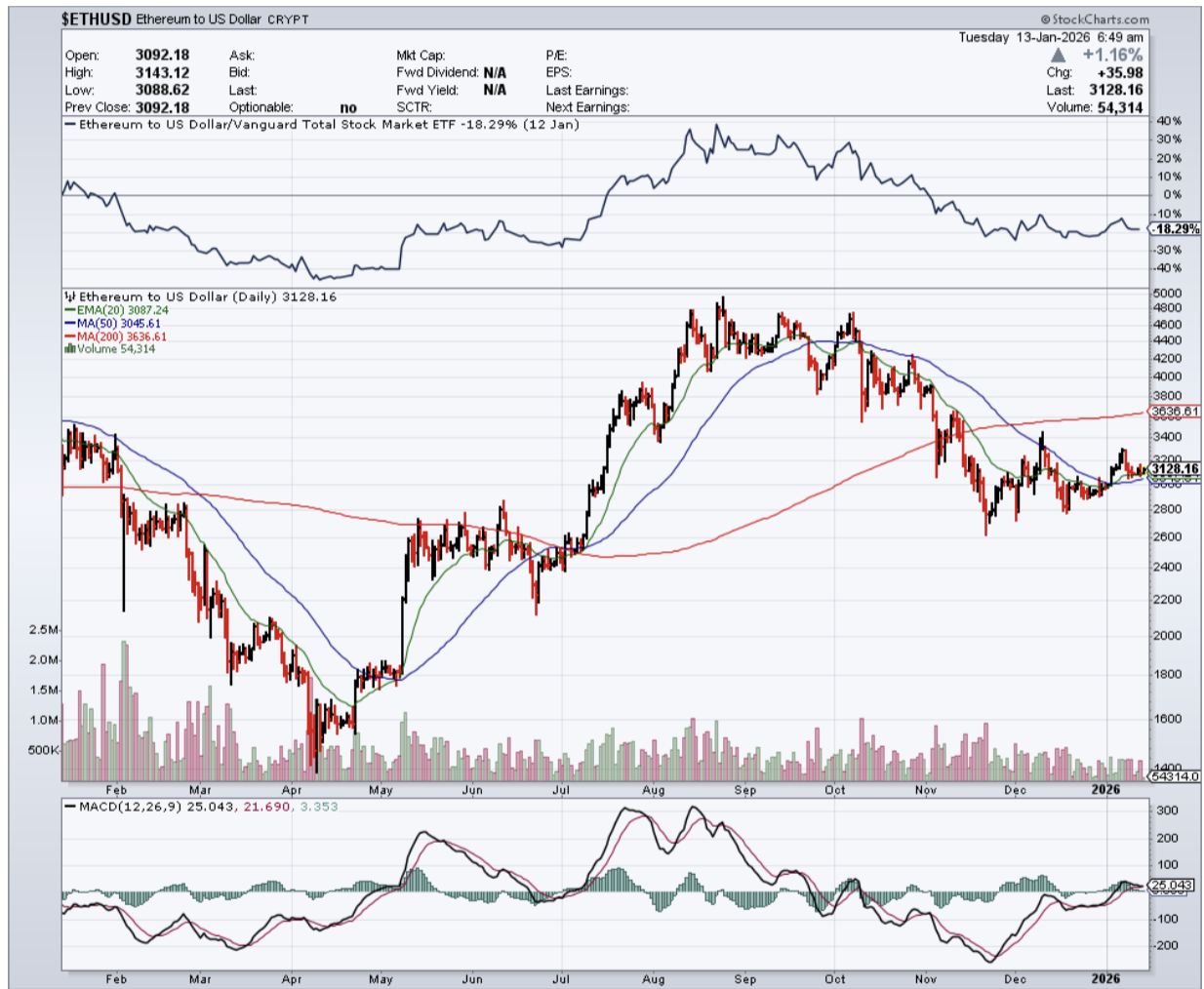
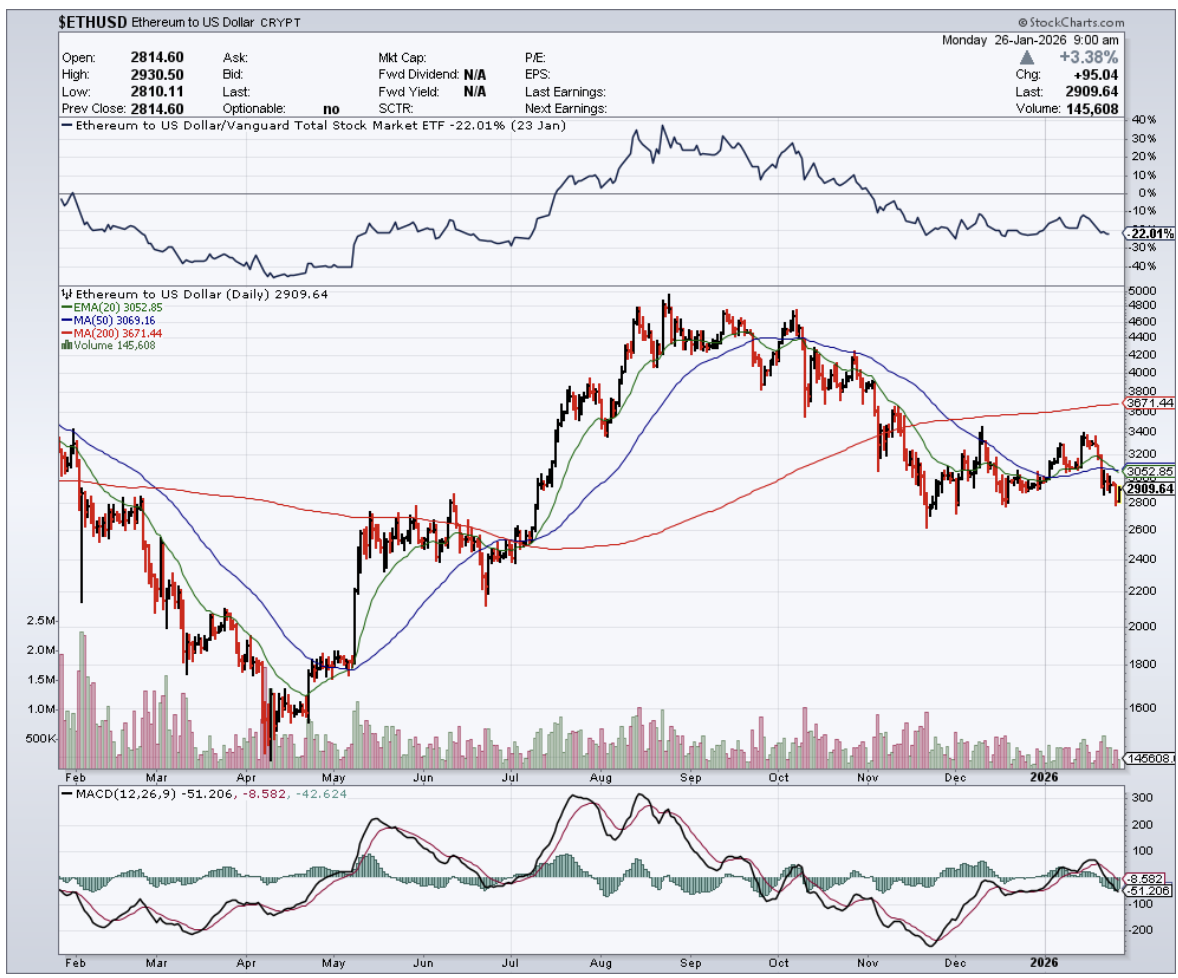
It has recently traded around $3,000, and ETH continues to position itself as core infrastructure for the digital asset economy.

Ultimately, while near term price targets are always speculative, ETH has already traded well beyond prior cycle highs, and future upside will likely be driven less by hype and more by adoption, fee generation, and real economic usage.


https://madhedgefundtrader.com/wp-content/uploads/2019/05/cropped-mad-hedge-logo-transparent-192x192_f9578834168ba24df3eb53916a12c882.png 0 0 Mad Hedge Fund Trader https://madhedgefundtrader.com/wp-content/uploads/2019/05/cropped-mad-hedge-logo-transparent-192x192_f9578834168ba24df3eb53916a12c882.png Mad Hedge Fund Trader2026-01-13 13:00:092026-01-21 13:21:10The Appeal of Ethereum
april@madhedgefundtrader.com

Alternative Tech Gets Hammered

Tech Letter

The goalposts are narrowing with liquidity not making it out to the outer edge of the risk spectrum.

Bitcoin has had some weaknesses but the alternative currencies have really felt the guillotine drop.

When push comes to shove, the tide doesn’t lift all boats in eroding economic conditions.

Yes, we are about to start cutting rates, but that is because the economy is starting to stagnate and tech stocks have felt the full brunt of it.

Tech stocks have had a rough September and it was going to take a lot to move the needle with these lofty prices. 

It was about time that investors took profits.

What has that meant for crypto?

It means a grim short-term outlook that the industry will need to endure.

11 U.S. spot bitcoin exchange-traded funds had their worst day in over four months after the report, as more than $287 million was collectively withdrawn from the ETFs.

The data was bad through the end of the week. On Friday, the Bureau of Labor Statistics reported a cooldown in the labor market with August payrolls falling short of expectations.

Last week, Cryptocurrency exchange Coinbase wrapped up its worst week of the year. Bitcoin miner Marathon Digital tumbled 20%.

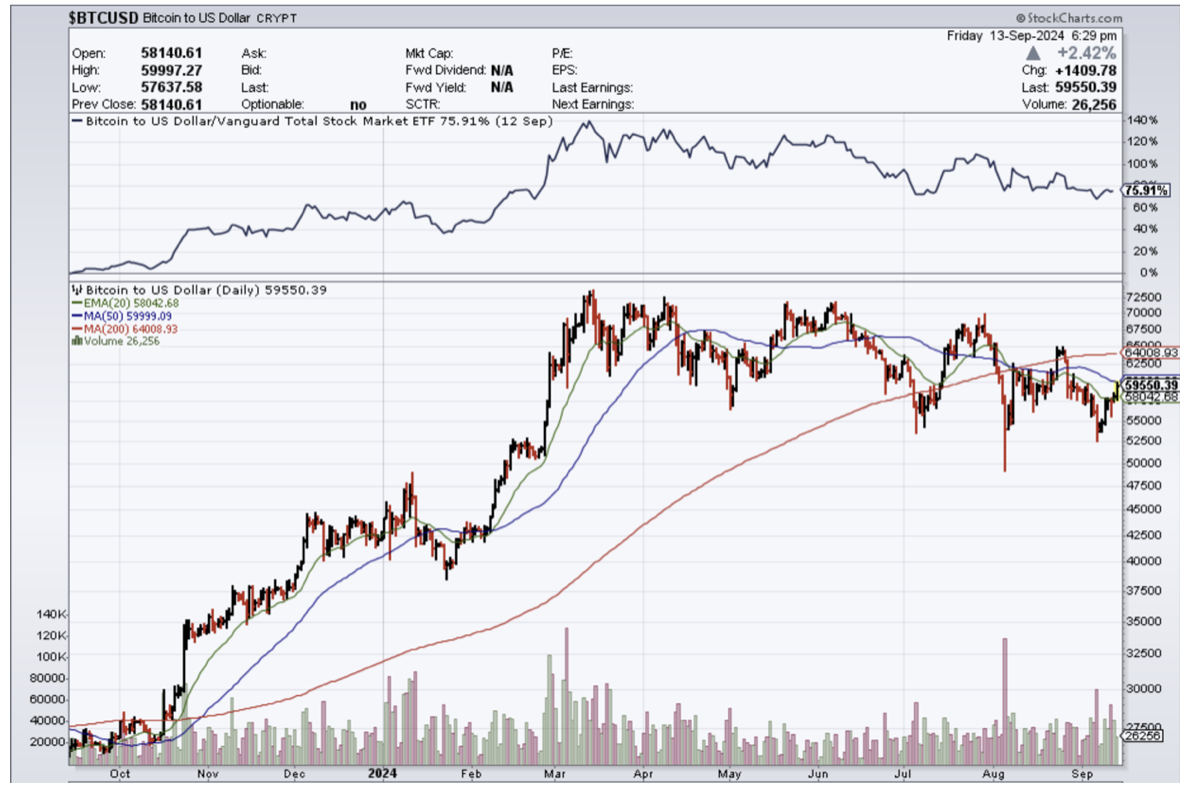
September is historically a difficult trading month for crypto assets, with bitcoin notching an average loss of 4.8%.

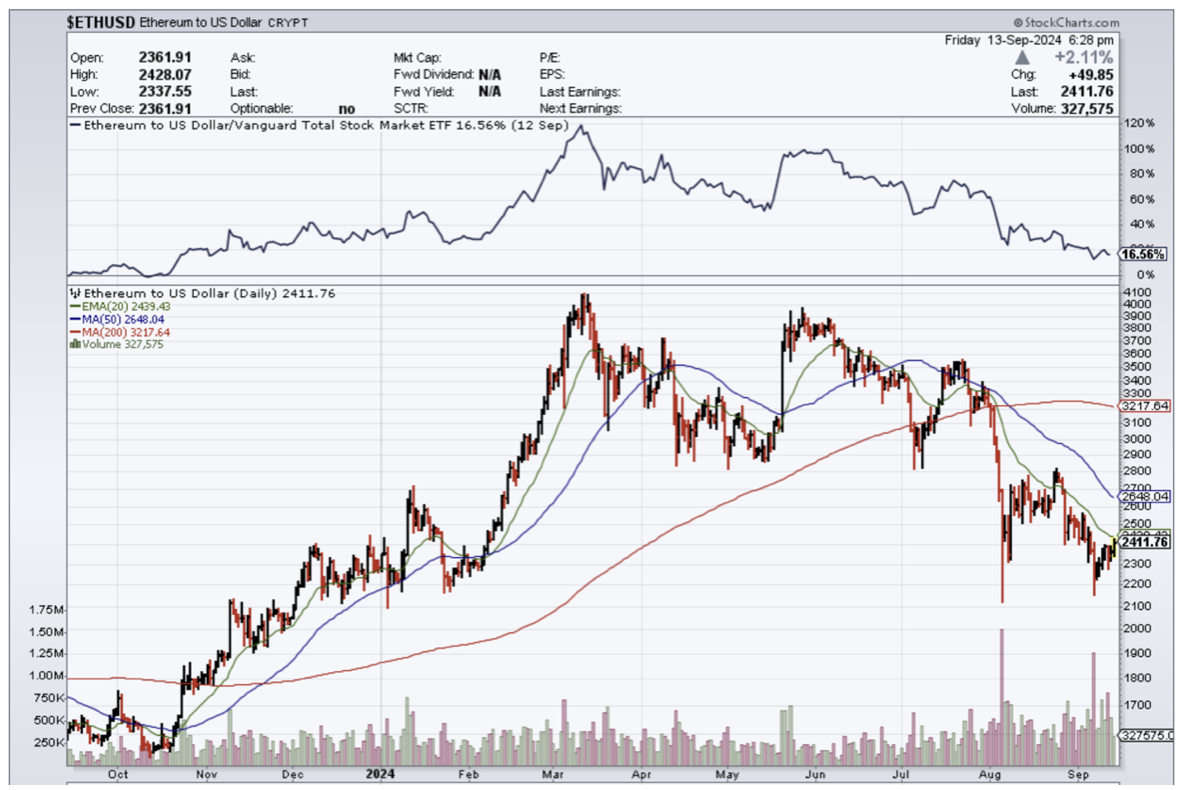
The total market cap of crypto is down close to 30% from its 2024 peak of $2.67 trillion and is now at $1.9 trillion. Altcoins like Solana’s token, XRP, and Cardano’s ADA all dropped more than 8% last week.

While it was a rough week for risky assets of all sorts, investors over-indexed in crypto stocks had it particularly bad.

Coinbase, stuck in a court battle with the SEC over whether the exchange engages in unregistered sales of securities, plummeted 20% to its lowest since February. MicroStrategy, the bitcoin collecting company founded by Michael Saylor, dropped 26% in the last two weeks.

The top Bitcoin mining companies all ended last week with double-digit declines, led by CleanSpark’s 24% plunge. Riot Platforms lost 17%.

As investors turn to what’s coming, one big area of focus is the Federal Reserve.

If the Fed does in fact lower rates, I do see crypto and tech stocks reflating.

However, some alternative crypto stocks might get left behind and I fear for an asset like ether which was once seen as the second-best crypto.

Ether’s price has fallen to the point that suggests it really isn’t that important to the crypto industry.

Bitcoin has stood out as the all-weather crypto asset that could benefit most during the easing cycle.

In truth, technology stocks delivered some type of mini miracle by performing well when rates turned higher.

There is definitely a good chance that initiating a lower rate cycle might add rocket fuel to tech stocks.

Remember that tech stocks are the only equities that have grown their earnings during the past few years.

Much of the recent success is also due to chip stock Nvidia which has led the charge for tech companies surging past other big tech companies as the most influential stock in the world.

As we shake out the good from the bad, I urge readers to get into the best of breed, in tech and not crypto, when risk is initiated again.

I also urge caution to anyone who likes to get into crypto that it is a high-risk asset that could get dumped one day if people need capital to pay for mortgages and food.


https://madhedgefundtrader.com/wp-content/uploads/2019/05/cropped-mad-hedge-logo-transparent-192x192_f9578834168ba24df3eb53916a12c882.png 0 0 april@madhedgefundtrader.com https://madhedgefundtrader.com/wp-content/uploads/2019/05/cropped-mad-hedge-logo-transparent-192x192_f9578834168ba24df3eb53916a12c882.png april@madhedgefundtrader.com2024-09-13 14:02:132024-09-13 15:35:07Alternative Tech Gets Hammered
Mad Hedge Fund Trader

Looking For A Savior

Bitcoin Letter

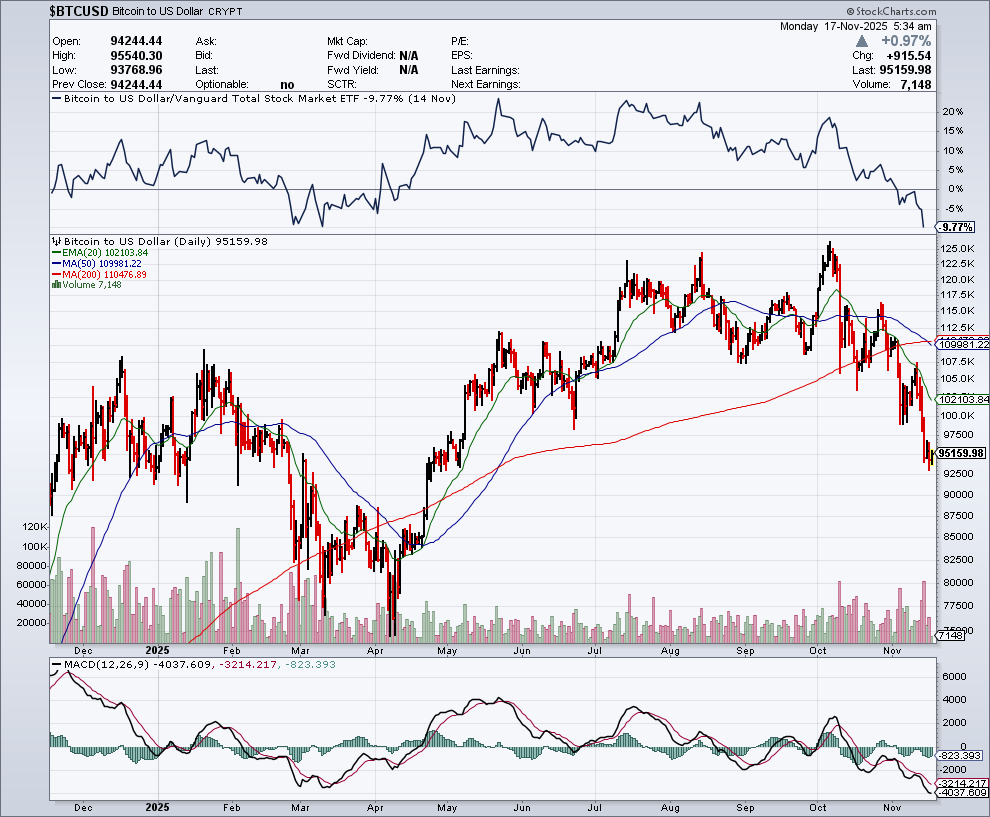
Bitcoin slipped to around $95,000 this week after a delayed U.S. inflation print and hawkish Federal Reserve commentary raised doubts about a near-term rate cut.

The result means that another modest adjustment in interest rates is already priced into the markets; traders are now focused on whether further cuts or hikes will follow.

There was some fleeting hope back in 2022 that the Federal Reserve wouldn’t need to tighten further, but those ideas were dashed as inflation surged. 

A similar dynamic persists in 2025: markets still swing whenever inflation surprises, even though today’s debate is about the timing of cuts rather than large hikes.

Let me remind readers that the US Central Bank employs over 10,000 Ivy League-trained economists earning well over $150,000, yet they are navigating a policy landscape still shaped by earlier missteps.

The longer the Fed allows persistent inflation to erode the health of the US economy, it could be argued that we might be living in an America with only rich and poor people in the future. While “hyperinflation” never arrived, multi-year price increases still stoke that concern.

How does this affect cryptocurrency?

In one word – devastating.

Crypto is reliant on low rates to fuel overperformance.

High liquidity is necessary too.

However, we diverged from those two pillars through 2023–2024, and only recently has easing begun to appear on the horizon.

Crypto, like physical gold, needs rates to be low to represent an attractive investment because of its speculative nature.

The uncertainty now centers on whether the Federal Reserve will delay rate cuts into early 2026.

So what did the price of Bitcoin do upon hearing this news?

In 2022, Bitcoin slid toward $18,000 on similar macro fears. Today, it fell toward $95,000 as traders reassessed the timing of future rate cuts rather than hikes.

Cryptocurrencies had been trading mostly sideways at times earlier in 2025, but Bitcoin’s consolidation ranges now span tens of thousands of dollars, not hundreds.

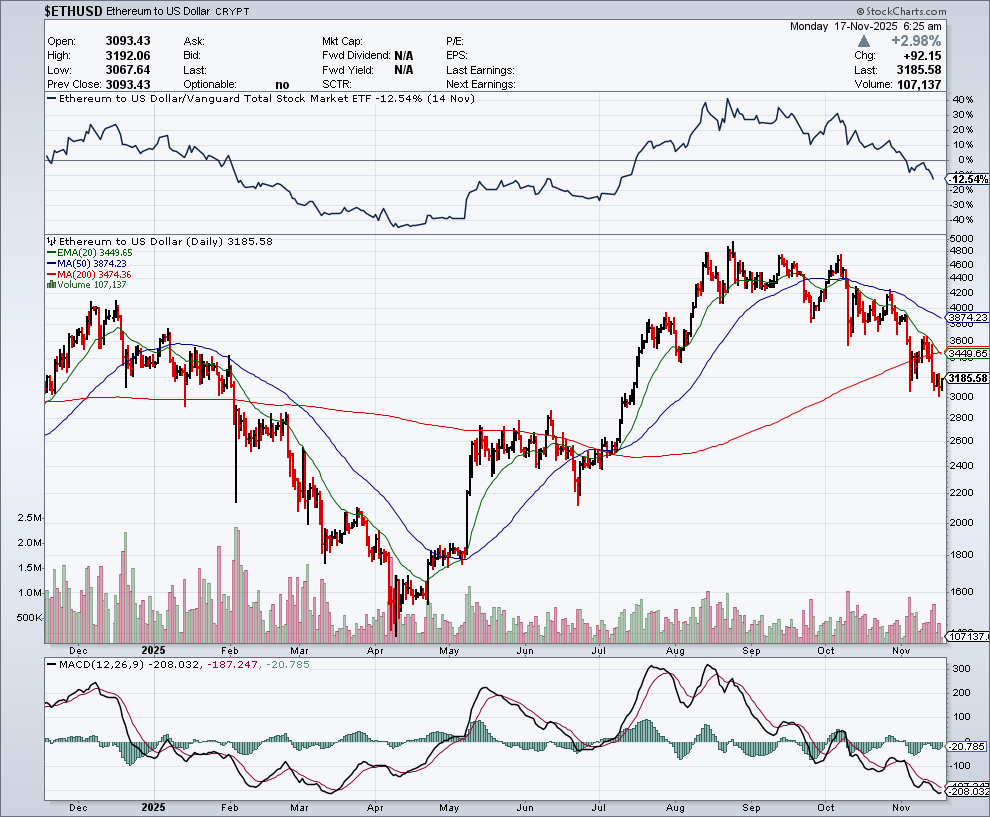
That’s been a key shift, and a clear move lower this year led to correction lows near $74,000 for Bitcoin. Ether’s mid-2025 lows were near $3,500.

Clearly, there is a lot to worry about for readers who are heavy crypto traders.

Moderating but sticky inflation still leaves the economy vulnerable to price spikes heading into winter.

My guess is that upcoming high inflation data will show up in the form of elevated utility bills, particularly in natural gas.

The sabotage and geopolitical tensions that disrupted energy supply in prior years still echo through markets, and OPEC’s decisions continue to have global effects.

The negative events are just piling on top of each other at this point.

I just don’t see how Bitcoin sustains itself above six-figure territory in the short term.

If it does surpass $120,000 because of a bear-market rally, traders will take profits yet again, rinse and repeat.

Although equity markets may rally through the day, this remains another reminder of the strategic fragility of this alternative asset that once offered so much hope.

Crypto has turned into nothing more than an ultra-speculative asset that, in times of tight liquidity, goes on life support.

It remains volatile, and although institutional adoption and ETFs have added legitimacy, its price still fails many traditional store-of-value tests.

Sell any rally over $120,000 because it won’t last there long.


https://madhedgefundtrader.com/wp-content/uploads/2019/05/cropped-mad-hedge-logo-transparent-192x192_f9578834168ba24df3eb53916a12c882.png 0 0 Mad Hedge Fund Trader https://madhedgefundtrader.com/wp-content/uploads/2019/05/cropped-mad-hedge-logo-transparent-192x192_f9578834168ba24df3eb53916a12c882.png Mad Hedge Fund Trader2022-10-13 15:02:212025-11-17 02:28:22Looking For A Savior
Mad Hedge Fund Trader

October 11, 2022

Bitcoin Letter

Mad Hedge Bitcoin Letter
October 11, 2022
Fiat Lux

Featured Trade:

(KOWTOWS TO THE INSTITUTIONS)
(BTC), (ETH), (COIN), (GOOGL)

https://madhedgefundtrader.com/wp-content/uploads/2019/05/cropped-mad-hedge-logo-transparent-192x192_f9578834168ba24df3eb53916a12c882.png 0 0 Mad Hedge Fund Trader https://madhedgefundtrader.com/wp-content/uploads/2019/05/cropped-mad-hedge-logo-transparent-192x192_f9578834168ba24df3eb53916a12c882.png Mad Hedge Fund Trader2022-10-11 16:04:572022-10-11 16:26:34October 11, 2022
Mad Hedge Fund Trader

Kowtows to the Institutions

Bitcoin Letter

Google allowing crypto payments to its cloud services from Coinbase Global (COIN) doesn’t move the needle.

COIN is the crypto exchange platform that has run into a litany of problems recently, from falling trading volumes and regulatory fines to shifting strategic focus.

The news is a footnote to the carnage that is really happening front and center in the crypto market.

Funnily enough, why would a customer choose to pay for Google’s cloud services through Coinbase when fees are still meaningful and alternative rails (cards, bank transfers) dominate?

Crypto isn’t cheap, and it doesn’t pretend to be.

Ether (ETH) remains infamous for its “gas fees.” In 2021, they averaged around $63 for one transaction, which contributed to its lag behind other networks.

In 2025, the network has improved (via upgrades like Dencun and protocol optimizations), but fee-peaks still occur and many users have migrated to layer-2s or alternative chains.

Bank ACH transfers are free or very low cost, and so are most debit/credit card purchases.

Even though El Salvador claims to be a crypto-first economy, most everyday transactions continue to be completed in cash or U.S. dollars.

At least crypto will now be allowed to transact on Google’s platform (or at least participate via some rails), which is a victory in itself, but I don’t believe this will catch on like wildfire.

Crypto is up against a Sisyphean task.

The Google Cloud infrastructure service will initially accept cryptocurrency or crypto-adjacent payments from a limited set of customers; the roll-out is far from universal. Meanwhile, Google has pivoted toward broader payments infrastructure, agentic AI commerce and blockchain layers.

Over time, Google may allow more customers to make payments via crypto or stablecoins but the emphasis is no longer solely “pay with Bitcoin/Ether” but “use stablecoins or tokenized rails.”

Coinbase will (or already does) earn a percentage of transactions that go through whatever rail they enable but the margin of that business remains tiny relative to its overall operations.

It remains high risk to hold crypto on the balance sheet. Coinbase no longer flags a large impairment charge the way it did in 2022, but it continues to grapple with volatility and shrinking core trading revenue. In Q2 2025, Coinbase’s revenue fell to about $1.5 billion, with consumer spot trading volumes down ~45% year-over-year.

Therefore, I expect Google (or Google’s payment rail) to charge a fee or apply a conversion spread to turn crypto in and out of fiat - just as before - or to prefer stablecoin/fiat rails entirely.

From the outside, this really does look like a marketing gimmick.

Blockchain technologies, such as non-fungible tokens (NFTs), have moved out of the “wild hype” phase; for Google’s cloud division the bigger focus now is on tokenized assets, stablecoin infrastructure, AI-agent payments, and building developer tools around these. 

Google has announced the Agent Payments Protocol (AP2), an open standard for AI-agent-led payments that supports stablecoins among other rails.

Previously, Google pushed for growth in major industries such as media and retail. This year, it started forming more teams around blockchain, payments infrastructure and “Web3” tooling but the narrative has shifted from “crypto payments” to “tokenized finance + AI commerce.”

However, I thought that crypto was going at its lone-wolf style hoping to create a parallel system to the fiat money system which it despises.

Apparently not.

Tying up with a mega-tech corporate firm sounds like they are giving up to me.

It seems as if the founding investors are ready to cash out and leave the die-hard crypto believers for a more stable income stream.

Annuity-like income stream is something many crypto firms lack and locating one is a hard sell.

Crypto was supposed to be “decentralized” but this appears to be a move that will offer Google the keys to Coinbase’s data while limiting them to lateral moves.

In short, this is a move that allows more centralization in the biggest crypto platform in the United States.

Growth was crypto’s calling card and that means parabolic growth possibilities are over.

Integrating with Google also means Google will have deep insight into how they can use Coinbase to profit from digital currencies - since Coinbase has agreed to onboard their data onto Google’s cloud infrastructure in some capacity.

Honestly, this is a bone-head strategic move for Coinbase, and my inclination would be to buy Google’s stock if one believes in crypto.

Desperation can trigger some unusual moves and we are seeing that in real time. But analyzing the bleak short-term prospects for crypto, this might be a move for survival rather than anything else.

https://madhedgefundtrader.com/wp-content/uploads/2019/05/cropped-mad-hedge-logo-transparent-192x192_f9578834168ba24df3eb53916a12c882.png 0 0 Mad Hedge Fund Trader https://madhedgefundtrader.com/wp-content/uploads/2019/05/cropped-mad-hedge-logo-transparent-192x192_f9578834168ba24df3eb53916a12c882.png Mad Hedge Fund Trader2022-10-11 16:02:552025-11-17 01:37:43Kowtows to the Institutions
Mad Hedge Fund Trader

October 4, 2022

Bitcoin Letter

Mad Hedge Bitcoin Letter
October 4, 2022
Fiat Lux

Featured Trade:

(ANOTHER SLIP-UP)
(FSOC), (MAX), (BTC), (ETH)

https://madhedgefundtrader.com/wp-content/uploads/2019/05/cropped-mad-hedge-logo-transparent-192x192_f9578834168ba24df3eb53916a12c882.png 0 0 Mad Hedge Fund Trader https://madhedgefundtrader.com/wp-content/uploads/2019/05/cropped-mad-hedge-logo-transparent-192x192_f9578834168ba24df3eb53916a12c882.png Mad Hedge Fund Trader2022-10-04 14:04:352022-10-04 15:14:17October 4, 2022
Page 1 of 8123›»

tastytrade, Inc. (“tastytrade”) has entered into a Marketing Agreement with Mad Hedge Fund Trader (“Marketing Agent”) whereby tastytrade pays compensation to Marketing Agent to recommend tastytrade’s brokerage services. The existence of this Marketing Agreement should not be deemed as an endorsement or recommendation of Marketing Agent by tastytrade and/or any of its affiliated companies. Neither tastytrade nor any of its affiliated companies is responsible for the privacy practices of Marketing Agent or this website. tastytrade does not warrant the accuracy or content of the products or services offered by Marketing Agent or this website. Marketing Agent is independent and is not an affiliate of tastytrade. 

Legal Disclaimer

There is a very high degree of risk involved in trading. Past results are not indicative of future returns. MadHedgeFundTrader.com and all individuals affiliated with this site assume no responsibilities for your trading and investment results. The indicators, strategies, columns, articles and all other features are for educational purposes only and should not be construed as investment advice. Information for futures trading observations are obtained from sources believed to be reliable, but we do not warrant its completeness or accuracy, or warrant any results from the use of the information. Your use of the trading observations is entirely at your own risk and it is your sole responsibility to evaluate the accuracy, completeness and usefulness of the information. You must assess the risk of any trade with your broker and make your own independent decisions regarding any securities mentioned herein. Affiliates of MadHedgeFundTrader.com may have a position or effect transactions in the securities described herein (or options thereon) and/or otherwise employ trading strategies that may be consistent or inconsistent with the provided strategies.

Copyright © 2026. Mad Hedge Fund Trader. All Rights Reserved. support@madhedgefundtrader.com
Scroll to top