Mad Hedge Biotech & Healthcare Letter
May 6, 2021
Fiat Lux
FEATURED TRADE:
(THE WHITE KNIGHT OF BIOPHARMA)
(PFE), (AMGN), (BMY), (LLY), (GILD), (MRK), (BNTX), (VTRS), (GSK)

Mad Hedge Biotech & Healthcare Letter
May 6, 2021
Fiat Lux
FEATURED TRADE:
(THE WHITE KNIGHT OF BIOPHARMA)
(PFE), (AMGN), (BMY), (LLY), (GILD), (MRK), (BNTX), (VTRS), (GSK)
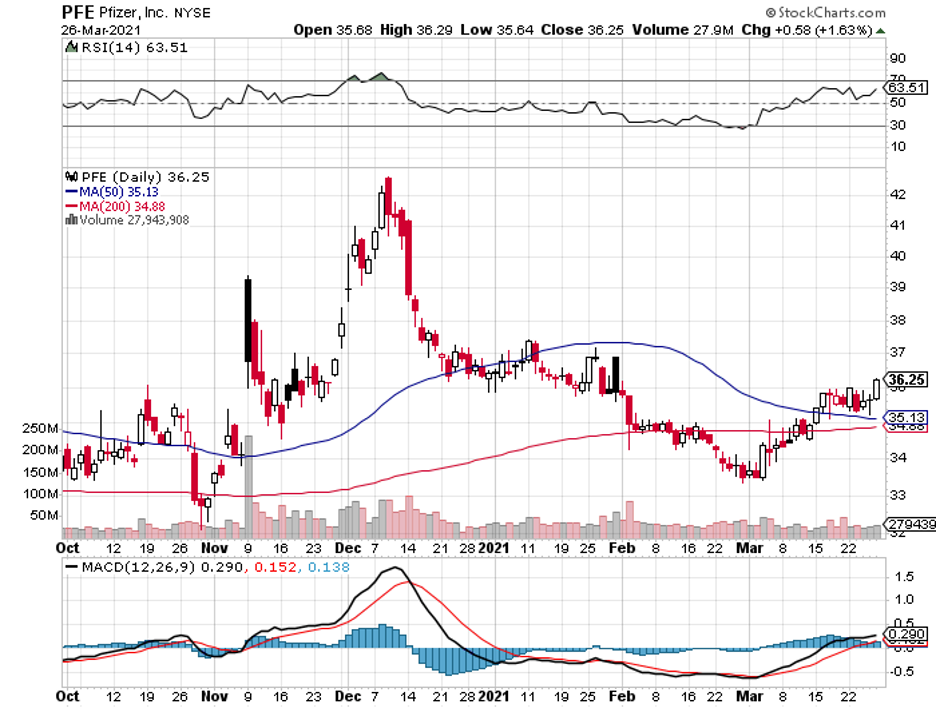
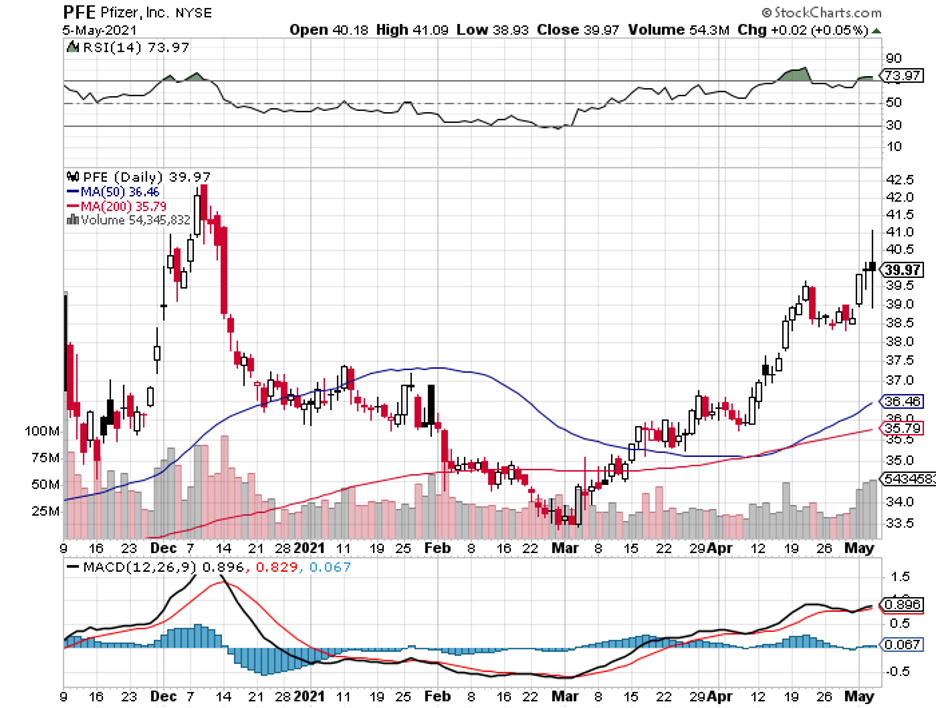
After a week of dissatisfying earnings reports from huge biopharmaceutical firms like Amgen (AMGN), Bristol-Myers Squibb (BMY), Eli Lilly (LLY), Gilead Sciences (GILD), and Merck (MRK), one company has managed to buck the trend: Pfizer (PFE).
In its first quarter earnings report for 2021, Pfizer reported adjusted diluted earnings of 93 cents per share, surpassing the earlier experts’ estimate of 77 cents.
Even its reported revenue exceeded the earlier predictions of $13.4 billion, raking in $14.6 billion during the period instead.
Aside from those, Pfizer also massively boosted its projected revenue from the COVID-19 vaccine it developed with BioNTech (BNTX).
Pfizer’s COVID-19 vaccine is slated for approval to be used for 12- to 15-year-olds by next week.
On top of these, the company expects data from its third COVID-19 vaccine candidate. This recent trial is for a booster dose, which could have results by early July and possibly a full emergency approval later on the same month.
The company now estimates $26 billion in sales for the vaccine, which is notably up from its $15 billion projection in February 2021.
Pfizer is also confident in its capacity to manufacture at least 3 billion doses of the COVID-19 vaccine in 2022, with the company already negotiating agreements with countries for their 2022 supply and beyond.
While the huge boost in the company’s COVID-19 vaccine sales expectations definitely grabs headlines, Pfizer’s base business brought in notable results as well.
Apart from the vaccine, the company’s operational growth in the first quarter was mostly driven by the sales from its blood clot treatment Eliquis, which went up by 25% operationally.
Sales of its heart drug Vyndagel soared by 88%, while its cancer drug Xeljanz jumped 18%.
One of the most notable moves from Pfizer is spinning off its off-patent drug division, Upjohn, to form a new company with generic drug developer Mylan, called Viatris (VTRS).
This decision would rid Pfizer of several well-known products, such as Viagra, Lyrica, Lipitor, Celebrex, and Chantix, which were responsible for roughly 15% of its total revenues.
However, sales for these items fell by 30% in the first nine months of 2020 alone—a chronically falling performance since 2017.
By eliminating the products that no longer hold any exclusivity rights and signing them off to Viatris, Pfizer can focus on developing and marketing new and innovative treatments.
So far, this strategy has started to bear fruit.
At the moment, Pfizer has several attractive assets in its pipeline. One of them is non-small cell lung cancer (NSCLC) treatment Lorbrena, which could become one of the highest-selling products in the oncology market.
Lorbrena is estimated to grow to over $40 billion each year by the mid-2020s.
At this point, the drug is in its registration phase and was granted a priority-review status. That means approval is on the horizon in the not-so-distant future.
Other potential blockbuster oncology assets include prostate cancer drug Xtandi, NSCLC treatment Bavencio, and breast cancer medication Ibrance.
All these are in late-stage trials, which means they should be available to market soon.
In total, Pfizer currently has at least 33 drugs queued in either Phase 3 trials or registration. The list includes vaccine candidates, immunology treatments, and, of course, oncology assets.
While Pfizer lost Upjohn in 2020, it gained a new partner in GlaxoSmithKline (GSK). The two companies decided to merge their consumer healthcare programs.
This made them the biggest provider of non-prescription drugs across the globe.
By shedding its sluggishly growing assets, Pfizer managed to develop its culture into one that concentrates on developing and marketing new and innovative products.
Additionally, the company’s current portfolio holds several growing products with the potential for expansion.
Given all these changes, Pfizer raised its financial guidance for 2021 as well.
For this year, the company now estimates adjusted diluted earnings to be valued between $3.55 and $3.65 per share compared to the previous range of $3.10 to $3.20 per share.
In terms of its full-year revenue, the company raised it from its estimate between $59.4 billion and $61.4 billion to $70.50 billion and $72.5 billion.
In terms of its projected revenue compound annual growth rate, Pfizer reconfirmed that it could deliver at least 6% through 2025 and a double-digit growth on its bottom line.
Remarkably, this is still not taking into consideration its COVID-19 vaccine.
If you pull out the revenues from its COVID-19 vaccine, then the company’s projected EPS growth for 2021 is at 15%.
Adding the vaccine into the equation gives us an impressive 41% increase in its EPS.
If you consider the wild card that is Pfizer’s COVID-19 vaccine, which would include a price increase coupled with the possibility of booster shots administered annually, and combine it with its base business, then it’s easy to see how the company’s growth could be turbocharged in the next few years.
Mad Hedge Biotech & Healthcare Letter
April 15, 2021
Fiat Lux
FEATURED TRADE:
(BET ON THIS BIOTECH STALWART)
(BIIB), (LLY), (RHHBY), (SAGE)
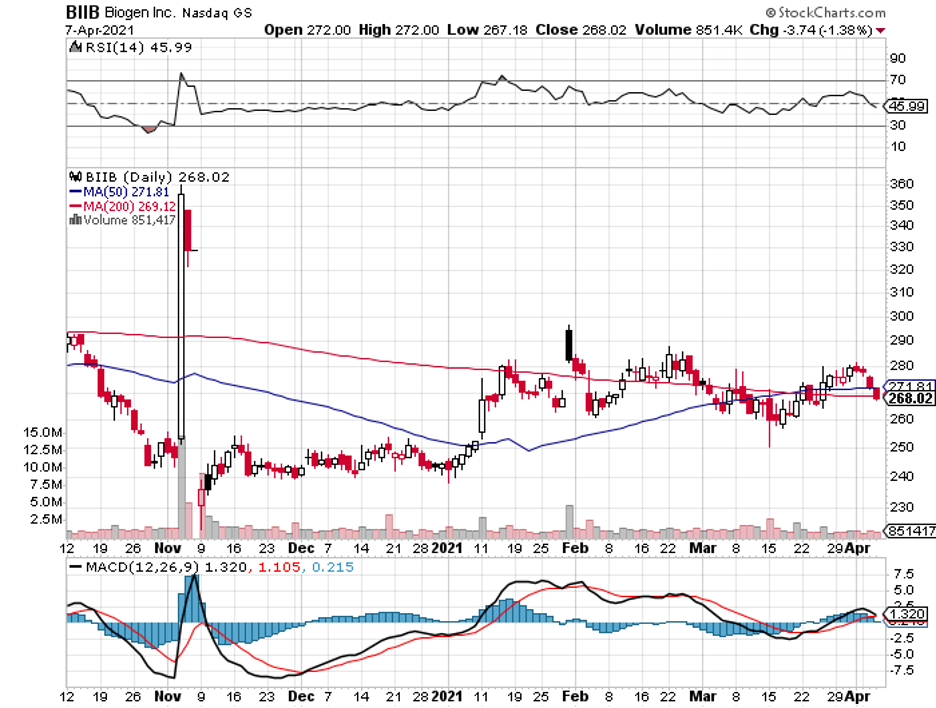
Biogen’s (BIIB) move to develop the first approved treatment for Alzheimer’s disease remains the biggest story in the biotechnology industry.
Now, we’re down to the waiting part of the process as the US Food and Drug Administration reviews the drug, Aducanumab.
If successful, then Aducanumab could generate a whopping $12 billion in peak sales.
The approval could also push Biogen stock up to $400. Meanwhile, a failure could let it spiral to $200.
Aside from the United States, Biogen has also applied for approval in Europe and Japan.
Apart from Aducanumab, Biogen has another Alzheimer’s disease treatment candidate, Gosuranemab.
For comparison, Aducanumab targets the amyloid plaque in the brain while Gosuranemab targets another kind of brain protein, called tau. This candidate is currently undergoing a Phase 2 trial, with results expected to be released by June this year.
While there’s still not much to go on in terms of the efficacy of Gosuranemab, positive data from its study is estimated to push Biogen stock to reach into the $350 ballpark if we base it on previous movements involving Aducanumab.
Although Biogen is definitely the face of the race to find an approved treatment for Alzheimer’s disease, it’s not alone.
To date, its strongest competitors are Eli Lilly (LLY) with Donanemab and Roche (RHHBY) with Gantenerumab.
Outside its Alzheimer’s disease programs, Biogen has been working with Sage Therapeutics (SAGE) on another potential blockbuster.
The two companies have been developing a depression drug, Zuranolone, and the data so far have offered promising results.
Like Gosuranemab, Biogen expects data on the study in the first half of 2021 as well.
If the study on Zuranolone turns out positive results, then Biogen shares are projected to jump by as much as $72.
While all these are promising, less aggressive investors may not find Biogen a suitable investment at this point. Evidently, the stock brings with it a lot of risks.
Aside from the uncertainty of its Alzheimer’s programs, there’s also the ongoing patent battle involving one of its top-selling drugs, multiple sclerosis treatment Tecfidera.
When the company lost its patent exclusivity, the FDA started to approve generic versions of Tecfidera.
This is a major concern for Biogen since Tecfidera is a substantial revenue source.
For context, this drug generated $4.4 billion in sales in the US in 2019 alone. By 2020, sales dropped to $2.6 billion.
Now, sales for this drug are estimated to reach only $1.6 billion in 2021.
While Biogen appealed its loss of patent exclusivity, the company has already taken steps to continue benefiting from Tecfidera’s success.
An obvious effort is the launch of a newer and more potent multiple sclerosis drug, Vumerity.
To attract patients and retain its customers, Biogen has been marketing Vumerity as a more powerful and effective version of Tecfidera.
In terms of the uncertainty brought by Aducanumab, it’s true that gaining FDA approval would have the Biogen stock skyrocketing.
However, rejection won’t be as devastating to the stock. While shares are expected to fall if that happens, the suffering would be short-term.
In the long run, Vumerity will gradually gain traction and eventually reach the level of success of Tecfidera, while the rest of Biogen’s pipeline programs hold the potential to add to the company’s revenue stream.
After all, Biogen is one of the first names that comes to mind when you hear the word “biotech.”
Founded in 1978, this biotechnology company has amassed a market capitalization of more than $40 billion and multiplied its annual profit to over 200%.
While its gamble on finding a treatment for Alzheimer’s disease is a risk that not a lot of investors would be willing to take, Biogen still holds one of the most promising pipeline programs in the industry and a portfolio of existing drugs with notable potential.
Going forward, approval for Aducanumab would mean a massive year for shareholders of Biogen.
If not, then this is still a respectable company with strong rewards and worth investing in, especially if you buy the dips.
Mad Hedge Biotech & Healthcare Letter
April 13, 2021
Fiat Lux
FEATURED TRADE:
(MEGA CAP PHARMA UP FOR GRABS)
(MRK), (ABMD), (ILMN), (ALGN), (JNJ), (GILD), (PAND), (ALKS), (IMV)
Since the great 2007 financial crisis, many companies have been coping to recapture their former glory. The healthcare industry is not spared of this struggle.
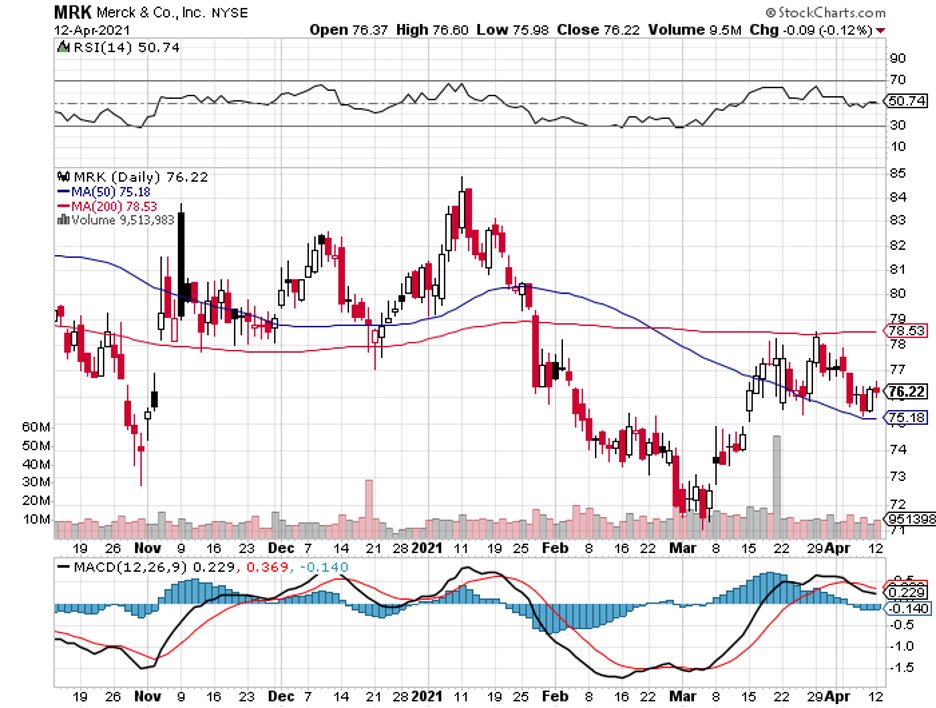
This makes the continuous growth of Merck (MRK) all the more impressive, with the company reaching $195 billion in market capitalization and sustaining its rise for over 130 years.
Curiously, Merck’s share price is still in the mid-$70s.
Meanwhile, other large-cap biopharmaceutical companies that offer similar products and services are trading higher.
For instance, the share price for Abiomed (ABMD) is over $330 while Illumina (ILMN) is nearly $400, and Align Technology (ALGN) is at a whopping $600.
Like Merck, investors gravitate towards Abiomed, Illumina, and Align because of their capacity to generate long-term sustainable revenues and boost earnings.
Notably, though, none of them hold the same depth or even breadth of products and services that Merck offers.
Recently, Merck disclosed some of its initiatives to boost the company’s earnings in the near- and long term.
One of the most visible efforts is its collaboration with Johnson & Johnson (JNJ) to help with the manufacturing of JNJ-78436735, in which Merck received federal funding.
While JNJ is one of the biggest healthcare companies across the globe, with a market capitalization of roughly $425 billion, joining forces with Merck will substantially boost its vaccine manufacturing capacity.
For context, JNJ’s goal prior to Merck’s help is to deliver 100 million doses by the end of the second quarter of 2021.
With Merck’s assistance, JNJ can now realistically manufacture up to 3 billion doses in 2022 alone.
This means that JNJ can implement a massive vaccination drive in the next two years since its manufacturing capacity ensures that it can deliver shots to over one-third of the population.
This is obviously good news for everyone as it means that the virus will be contained, but the enhanced manufacturing capacity also means profit accretion for both JNJ and Merck.
This partnership with JNJ is possibly a key factor in Merck’s move to invest heavily in the vaccine business.
Merck recently announced its plans to allocate $20 billion to expand its global vaccine manufacturing network from 2021 to 2024. This would mean an annual investment of $5 billion.
Part of this global vaccine plan is Merck’s acquisition of Pandion Therapeutics (PAND) in 2020.
Another recent initiative of the company is its joint effort with Gilead Sciences (GILD) to develop long-lasting HIV treatments.
Gilead will be in charge of the US market, while Merck will handle the EU and the rest of the international markets.
For starters, the companies will focus on a combination of Merck’s Islatravir and Gilead’s Lenacapavir to create a long-lasting and well-tolerate HIV treatment.
Outside these partnerships, Merck has been working on strengthening its oncology segment.
In fact, its top-selling drug, Keytruda, can be used to medicate an extensive range of indications, which include colorectal, esophageal, and even lung cancers.
At this point, Keytruda is generating north of $16 billion in sales every year and exhibiting roughly 30% growth annually.
Since the drug continues to gain approvals for additional indications, it looks like its growth runway is definitely far from over.
Keytruda is poised to reach $24 billion in annual sales in a few years’ time, which puts it on track to become the best-selling drug in the world by 2023.
Although Keytruda will be under patent protection until 2028, Merck remains active in expanding its oncology pipeline.
By then, Merck is projected to have multiple immunotherapy staples in its portfolio not only derived from its own R&D but also via partnerships like its 2020 collaboration with Alkermes (ALKS) to work on an ovarian cancer study and Immunovaccine (IMV) to cooperate on a blood cancer study.
The total oncology market is estimated to be $200 billion annually, with over 30 million cases projected to be added by 2040.
Overall, Merck is a well-oiled company that continues to deliver good results thanks to strategic acquisitions and partnerships neatly tied up together in a particular domain.
While its rival biotechnology and pharmaceutical companies become hot properties in the market and pose higher price tags, Merck silently moves forward in the shadows of sustainability and familiarity.
Mad Hedge Biotech & Healthcare Letter
April 8, 2021
Fiat Lux
FEATURED TRADE:
(A LOW-KEY POST-COVID-19 RECOVERY STOCK)
(REGN), (MRNA), (NVAX), (BNTX) (PFE), (VIR), (LLY), (RHHBY), (NVS)
If you still remember the news about the flash recovery from COVID-19 of then-President Trump during the campaign period last year, then you know that the express cure was not delivered by any of the vaccine makers that were all the rage at the time like Moderna (MRNA), Novavax (NVAX), BioNTech (BNTX), or even Pfizer (PFE).
Instead, the cure was credited to a lesser-known cocktail of antibodies, called REGEN-COV, developed by Regeneron (REGN).
Recently, the same treatment was used in Germany in response to the shortage of COVID-19 vaccines and the demand for alternatives.
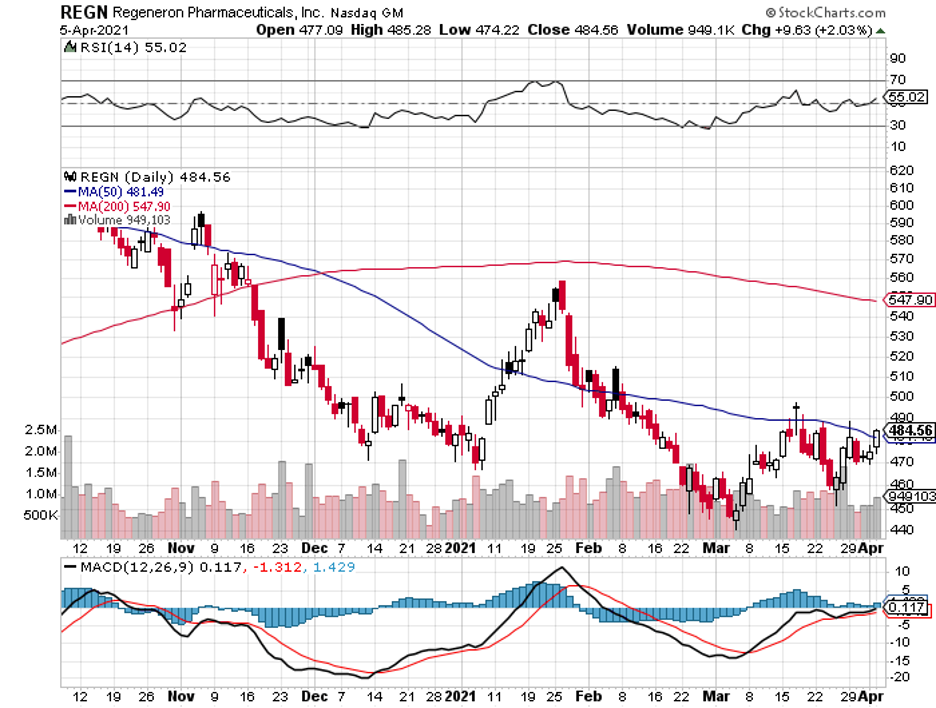
Despite the promising results and the highly publicized effects of Regeneron’s treatment, the company’s share price still hasn’t shown any meaningful upside.
Nonetheless, Regeneron still secured some agreements for REGEN-COV.
Based on the June 2020 agreement of Regeneron with the US government, the company expects to sell $260 million worth of REGEN-COV in the first quarter of 2021 for a fixed number of orders.
For the second quarter of 2021, though, the two parties set different terms for their deal.
Under these new terms, the US government will pay per dose regardless of REGEN-COV’s dose size.
Given the latest numbers from Regeneron’s trials, this could mean lower costs for the company.
Data from the clinical trials showed that REGEN-COV had the same effectiveness at the lower 1,200 mg dosage compared to the currently approved amount by the US FDA, which is 2,400 mg.
In fact, Regeneron’s treatment is reported to be as effective as the COVID-19 antibody therapies developed by Vir Biotechnology (VIR) and even Eli Lilly’s (LLY) candidate.
Looking at the positive results from Regeneron’s Phase 3 trials for REGEN-COV, it’s reasonable to expect higher sales than previously estimated.
Now, Regeneron shared that it aims to supply 1.25 million doses of the COVID-19 antibody therapy at the lower but equally effective 1,200 mg dose level.
If the FDA agrees to this emergency use authorization request, then Regeneron will be able to supply twice the number of COVID-19 doses.
If it delivers these doses by June 30, the US government will buy them for $2.6 billion regardless of the dosage used.
On average, Regeneron is expected to generate roughly $2.9 billion in sales for its COVID-19 antibody treatment.
Meanwhile, if REGEN-COV gains full FDA approval and gets marketed commercially, then the treatment can rake in at least $3.5 billion and peak at $5 billion this year alone.
Outside its COVID-19 program, Regeneron actually recorded better-than-expected results last year despite the pandemic ravishing the economy.
For example, there was a rebound in demand for its top-selling Eylea, with sales of the wet age-related macular degeneration (AMD) drug rising by 10% in the fourth quarter of 2020 to reach a total of $1.34 billion.
Bolstering the dominance of Eylea in the AMD market and to combat emerging competitors like Roche (RHHBY) with Faricimab and Novartis (NVS) with Beovu, Regeneron is looking to expand the drug’s application to cover more age groups.
Meanwhile, another bestseller, Dupixent, reached $1.17 billion in sales last year.
This is an impressive climb for the atopic dermatitis medication, which was developed with Sanofi (SNY), since it only recorded $751.5 million in the same period in 2019.
That indicates roughly 75% growth, with over a million prescriptions written for Dupixent in the US alone.
However, only 6% of those eligible patients have been treated with Regeneron’s product thus far.
This means that Dupixent has a lot of room to grow, with this drug estimated to reach peak sales at $12.5 billion.
Needless to say, Dupixent is quickly transforming into a blockbuster treatment.
Since its approval for eczema in 2017, this drug has expanded its indication to cover moderate-to-severe atopic dermatitis not only among teens but also children. Notably, Dupixent holds a monopoly for this application to children.
Another revenue stream for Regeneron is its oncology sector led by Libtayo.
In 2020, net sales of this skin cancer treatment reached $348 million, showing an impressive 80% growth.
To date, Regeneron has at least 12 oncology treatments under clinical development.
In terms of the bottom line, Regeneron exceeded the expectations of $8.38 and reported adjusted earnings per share of $9.53 instead.
As vaccine rollouts continue to be a priority, it’s safe to say that the worst of the COVID-19 is just about in sight.
Consequently, investors are now looking into recovery and stocks that appear to be good buys when the coronavirus eventually becomes a thing of the past.
Regeneron is one of the attractive buys so far. While it has been underperforming in the past weeks, its business actually looks to be in great shape even if the pandemic goes on for longer.
Mad Hedge Biotech & Healthcare Letter
March 30, 2021
Fiat Lux
FEATURED TRADE:
(A PURE PLAY STOCK SELLING AT A BARGAIN)
(PFE), (BNTX), (MRNA), (AZN), (JNJ), (NVAX), (MRK), (VTRS), (LLY), (REGN)
It’s virtually impossible to find a period in history when drug development gained the unmitigated attention of the whole world.
Yet, this is exactly what happened in 2020 when we all waited with bated breath for the results of COVID-19 trials from the likes of Pfizer (PFE), BioNTech (BNTX), Moderna (MRNA), AstraZeneca (AZN), Johnson & Johnson (JNJ), and Novavax (NVAX).
Despite this, it is astounding that biopharmaceutical stocks are cheaper than they have ever been in the past 20 years.
Given the fact that its collaboration with BioNTech made a central figure in the COVID-19 vaccine race, I think it’s best to put a spotlight on Pfizer today.
Pfizer was the first biopharmaceutical company to successfully market a COVID-19 vaccine, BNT162b2.
Recently, Pfizer received another good news. The FDA is no longer demanding that the company transport BNT162b2 at ultra-low temperatures.
When Pfizer revealed its strong results last year, the world was impressed and no one barely noticed the ultra-cold storage requirement that the achievement entailed.
But with competitors already gaining approvals as well, this particular requirement started to pose noticeable challenges to Pfizer’s vaccine supply chain and made it extremely challenging transporting the much-needed vaccines to remote areas.
These challenges highlight the significance of the recent FDA announcement regarding BNT162b2.
In terms of market share, Pfizer holds a significant advantage over the others.
As of the year-end of 2020, the company supplied 65 million doses to developed markets.
Meanwhile, the 2021 forecast for this product is at nearly 2 billion doses. This is estimated to rake in roughly $15 billion in revenue for Pfizer.
In comparison, Moderna’s advanced purchase deals are estimated to be worth $18 billion.
To sustain immunity, there’s the possibility that the vaccine would be needed annually.
This could lead to substantial demand for doses, with a two-dose vaccine like BNT162b2 projected to reach about 10 billion doses every year.
Realistically, the rising need for doses and the manufacturing requirements will obviously pressure profit margins.
However, if the vaccine does turn out to be an annual necessity, then it could become a valuable asset.
The entire COVID-19 market is estimated at $39 billion in 2021 and $23 billion in 2022.
Pfizer and even Moderna’s first mover advantage can easily help them dominate the market this year.
This means that the competition will heat up by 2022.
To ensure that it keeps the lead, Pfizer has commenced the Phase 1 trial for a COVID-19 pill.
Pfizer’s pill, dubbed PF-07321332, aims to inhibit the enzymes that cause the SARS-CoV-2 virus to replicate. The goal is to create an antiviral drug that works pretty much the same way as the one developed for HIV and Hepatitis C.
If the trials generate positive results, then PF-07321332 could be taken at the first sign of infection.
So far, lab results have shown the pill’s potent capacity to prevent the SARS-CoV-2 virus and other coronaviruses from replicating.
Pfizer isn’t the only one that came up with the idea of a COVID-19 pill. Merck (MRK), Eli Lilly (LLY), and Regeneron (REGN) have been conducting tests for their own version of the antiviral.
However, Pfizer is more than its COVID-19 programs.
In the past, investors wondered about the long-term growth potential of this company. Some questions are linked to its Upjohn unit, which included several products that lost patent exclusivity.
This segment clouded Pfizer’s pure play revenue and even its earnings growth. However, these questions were put to an end last year when Upjohn’s finally separated from Pfizer and formed a new company, Viatris (VTRS), with Mylan.
The effect of this move showed an amplified growth for Pfizer almost immediately.
In the fourth quarter alone of 2020, the company reported $11.68 billion in revenue, indicating a 12% increase year-over-year. If we exclude the sales from the COVID-19 vaccine, Pfizer’s revenue was still up by 8%.
Every key product segment in the company recorded revenue growth, which is remarkable considering the effects of the pandemic.
Revenue for its oncology sector went up 23% to reach $3 billion, with breast cancer treatment Ibrance leading the charge with an 11% boost to its sales to hit $1.4 billion.
To ensure that it corners the market, Pfizer also launched biosimilars Zirabev and Ruxience in the same quarter. Both generated $171 million in total.
Outside its COVID-19 program, other products in Pfizer’s vaccine segment significantly contributed to the 17% increase in revenue to reach $2 billion.
For example, the pneumonia vaccine Prevnar generated $1.8 billion thanks to the 10% boost in its revenue year-over-year.
As for Pfizer’s rare disease unit, revenue went up 24% to reach $865 million.
The segment leader so far is cardiomyopathy treatment Vyndagel, which achieved a jaw dropping 96% year-over-year boost in its revenue to generate $429 million. This product won’t face patent loss until 2026, so Pfizer still has a few more years to take advantage of it.
Pfizer’s revenues in 2020 were up 2% at $41.9 billion. Considering that it still managed to boost sales despite the pandemic, there’s a good chance that 2021 will be a better year for the company.
In fact, Pfizer estimates that it would reach nearly $60 billion in revenue, with an annualized EPS of roughly $3.15 in 2021.
Global sales in the biotechnology and healthcare industry are projected to be worth $1.2 trillion annually. This is a massive market that is all but guaranteed.
The S&P 500 trades at nearly 21.5x forward earnings, with pharmaceutical companies trading at only 13.2x. That’s a whopping 60% discount.
Considering that drug stocks have historically traded at roughly the same level as the S&P 500, the current situation still offers an unmistakable promise even if nothing else happens.
Continuous development in the sector not only advances our quality of life but also offers reasonable returns to investors.