• support@madhedgefundtrader.com
  • Member Login
Mad Hedge Fund Trader
  • Home
  • About
  • Store
  • Luncheons
  • Testimonials
  • Contact Us
  • Click to open the search input field Click to open the search input field Search
  • Menu Menu

Tag Archive for: (TRIP)

Mad Hedge Fund Trader

True Cost of the China Trade War

Tech Letter

As the trade misunderstanding escalates to a new stratum of ferociousness, certain parts of the economy are ripe to be battered.

Tourism and in particular, international travel, will be one of the first luxuries to be sliced off consumers' list.

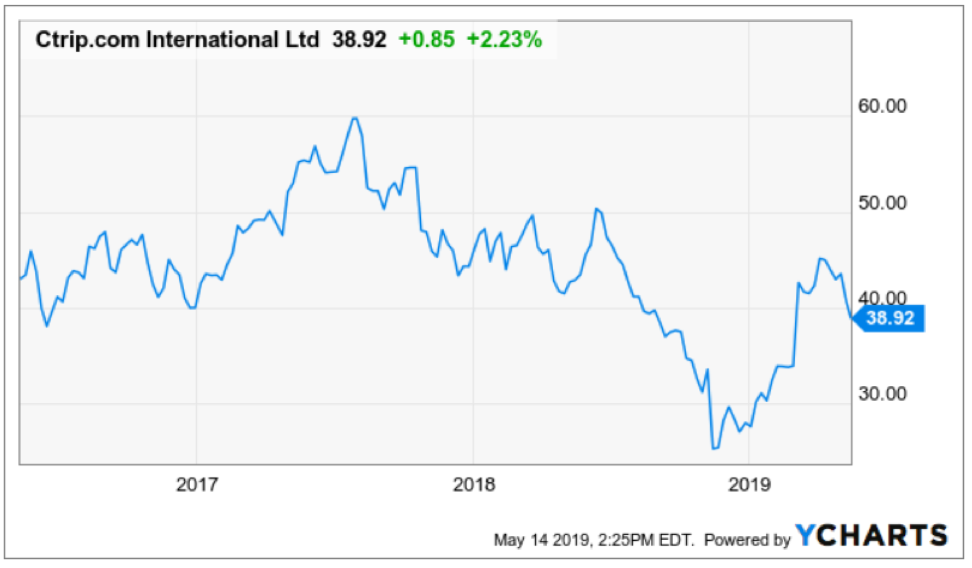
China’s most popular online travel agent Ctrip.com (CTRP) has suffered a damaging drop in demand from would-be international travelers.

Jonathan Grella, spokesman at the US Travel Association said, “The US runs a US$28 billion travel and tourism trade surplus with China” and preliminary numbers appear that Chinese travel to the US in the past year has dropped around 20%.

Compounding the woes is the weakening of the Chinese yuan which could become collateral damage from the trade negotiations if American and Chinese corporations repurpose supply chains to other countries and stop sending dollars to the mainland.

The ball is already rolling with 93 percent of Chinese companies considering making some changes to their supply chains to mitigate the effects of trade tariffs in an ingenious way to circumvent extra costs.

Of these, 18% are open to a complete supply chain remake and production transformation, with 58% making meaningful changes.

A further 17% plan to make minor tweaks in response to the trade war, with only 7% making no changes at all.

Chinese and American companies are reconsidering their Chinese manufacturing bases to avoid the tariffs placed on US$250 billion of Chinese exports by US President Donald Trump.

The unintended consequence will be a powerful surge in economic activity in South East Asia with also India benefitting from the chaos.

Apart from the supply chain complexities, the worsening of Chinese yuan strength could put a massive damper on Chinese international travel plans.

The annual Chinese international travel growth rate of 5.5% would be in dire straits translating into current travel demand rerouted to lower margin Asian countries such as Thailand, Vietnam, and Malaysia which are quite popular for budget travelers.

If lower sales do not manifest itself because tourists opt to forego expensive western countries, this demand will correlate into fewer dollars per traveler because of cheaper destinations which might force companies to double down on promotions to lure higher volume.

The same goes for American consumers who will be on the hook for the tariff-loaded consumer items that trickle onto our shores.

Decaying relations have already poisoned the US tourism sector that’s seen its growth flatline for the first time in 10 years.

And while only a small percentage of the 80 million visitors to the US in 2018 were Chinese, the potential for that segment’s growth remains robust.

Only 6 percent of Chinese citizens have passports signaling an imminent rise in outbound Chinese tourists that will reach 220 million by 2025.

The opportunity cost of these dollars migrating to other locations will be a kick in the teeth.

I reiterate my negative call for American online travel companies with recent damage control coming from TripAdvisor for last quarter’s debacle when the company reported dismal top-line results combined with a drop in monthly average unique visitors.

The company’s first-quarter revenues of $376 million missed badly up against the consensus forecast of $386.8 million.

TripAdvisor’s quarterly revenues fell 1% YOY as a result of the core hotel business underperforming and revenues from TripAdvisor’s Hotels, Media & Platform (or HM&P) showing zero growth at $254 million.

Revenues from its fringe businesses, which includes rentals, Flights/Cruise, SmarterTravel, and Travel China, plunged 33% to $42.

The proof is in the pudding with the company’s falling unique visitor count putting the kibosh on TripAdvisor’s growth prospects.

The company’s average monthly unique visitors cratered 5% YOY to 411 million users in the first quarter, contrasting with TripAdvisor’s performance last year when it reported an 11% YOY unique visitor growth.

Google is the boogie man in the equation with the company rolling out a more holistic travel product to integrate flight and hotel search functions while organizing people’s travel plans and saving research.

Alphabet will also repurpose more travel data on Google Maps, and integrate hotel and restaurant reservations for customers who are logged on.

Linking the Google travel and map functions seem like a no brainer to me and will be the precursor before the company starts selling ads on Google Maps including travel ads.

Google’s pivot into online travel marks an existential crisis for the incumbents and will strengthen its position in travel by driving further searches and potential higher-qualified leads for its partner companies, such as airlines and hotels.

Consumers have already recognized Google as the go-to place where to do travel research.

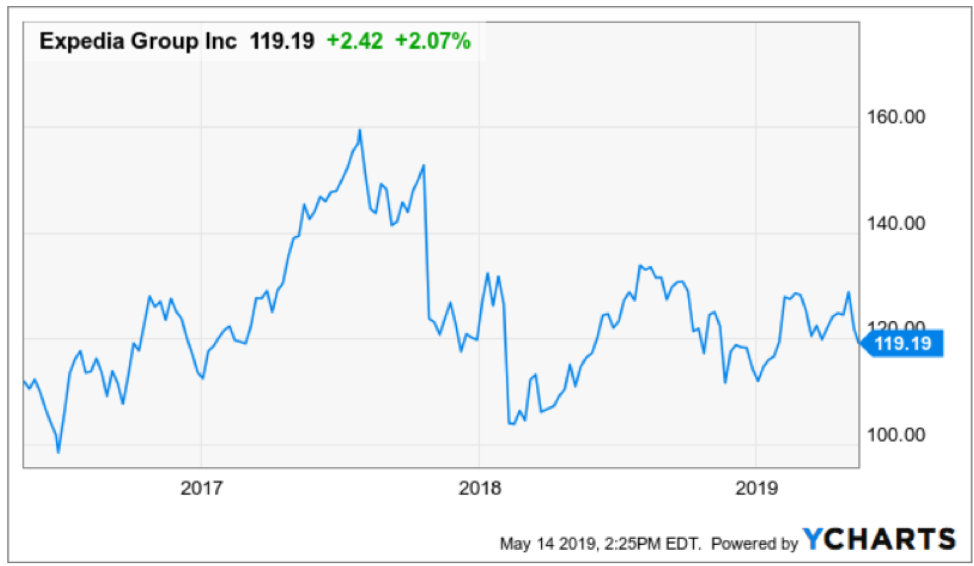
In a zero-sum game, Expedia (EXPE) and TripAdvisor (TRIP) will directly lose out.

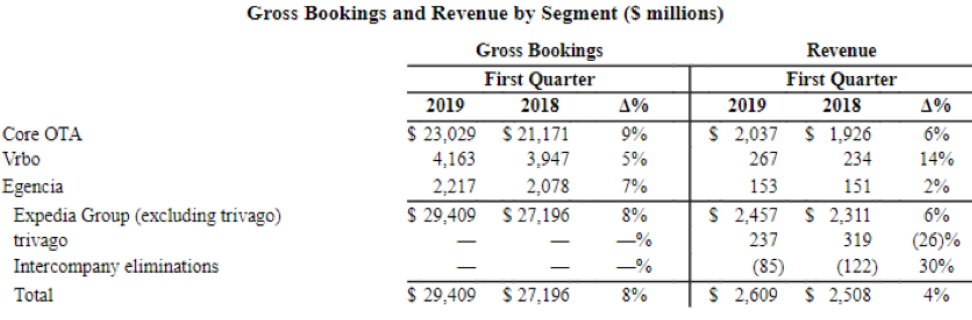
Highlighting the erosion was Expedia’s super growth asset Vrbo whose gross bookings totaled $4.16 billion, up a paltry 5 percent from a year earlier.

The growth rate was less than half of the main online travel agency business which should sound off alarm bells.

As it stands now, Google generates referral traffic although it does process some bookings on its own site for other travel merchants.

Unlike travel agencies such as Expedia or Priceline, Google doesn’t directly sell travel products such as hotel rooms or airline tickets but that could change quickly.

This ties back to my continuing thesis of the low-value proposition of broker apps in the tech ecosystem, either there will be one with a monopoly, or a bigger fish will hijack their business model and become the new monopolistic dominator.

Such is the high stakes of Silicon Valley in 2019.


https://madhedgefundtrader.com/wp-content/uploads/2019/05/cropped-mad-hedge-logo-transparent-192x192_f9578834168ba24df3eb53916a12c882.png 0 0 Mad Hedge Fund Trader https://madhedgefundtrader.com/wp-content/uploads/2019/05/cropped-mad-hedge-logo-transparent-192x192_f9578834168ba24df3eb53916a12c882.png Mad Hedge Fund Trader2019-05-15 02:02:302019-07-11 13:13:11True Cost of the China Trade War
Mad Hedge Fund Trader

February 14, 2019

Tech Letter

Mad Hedge Technology Letter
February 14, 2019
Fiat Lux

Featured Trade:

(FACEBOOK’S NEW PROBLEM),
(FB), (GOOGL), (TRIP), (EXPE)

https://madhedgefundtrader.com/wp-content/uploads/2019/05/cropped-mad-hedge-logo-transparent-192x192_f9578834168ba24df3eb53916a12c882.png 0 0 Mad Hedge Fund Trader https://madhedgefundtrader.com/wp-content/uploads/2019/05/cropped-mad-hedge-logo-transparent-192x192_f9578834168ba24df3eb53916a12c882.png Mad Hedge Fund Trader2019-02-14 03:07:282019-02-14 03:00:53February 14, 2019
Mad Hedge Fund Trader

Facebook's New Problem

Tech Letter

A major catalyst exacerbating recent tech layoffs has been a decline in referral traffic to news publishers from Facebook (FB).

Blame the algos!

Referral traffic is a way of reporting visits coming from a site from sources outside of the original site.

When someone clicks on a hyperlink leading to a different website, data analytics classified this as a referral visit to the second site by tracking mechanisms.

The truth is that news publishers have a painfully smaller window to monetize content than ever before and this opinion is echoed by some of big media’s stalwarts such as Rupert Murdoch, the chairman of News Corp.

Facebook decided to give preference to content in the news feed that is shared between Facebook users over those by news organizations, ironically, the news is being stripped out of the news feed whether that seems logical or not.

Under the guise of protecting the platform, Facebook is applying this ploy to further cut off users from escaping its walled garden trapping them inside for the purpose of clicking around the Facebook website even more.

As the technology evolves, companies are becoming increasingly pedantic in finding any practical method of allowing users to escape to another part of the internet.

Diminishing user time equals fewer clicks followed by reduced digital advertising revenue.

Another shift in Facebook rules entails elevating and demoting media outlets by trust levels and credible content that ultimately Facebook makes the decision on.

The algorithms in this case would prop up the more renowned institutions and essentially cut out minnow news organization.

Algorithms are inherently biased, and sources of revenue are cut off or opened up by these algorithmic shifts.

The monopolistic status of Facebook has made it near impossible for stand-alone firms to develop organically and ramping up digitally means leveraging Facebook ads to lure new customers.

What does this all mean?

News publications are bracing themselves for an atrocious year.

The side effect from recent changes mean that Facebook will ultimately become the God of the news cycle choosing which news populates where on the news feed or if it shows up at all.

Being a left-leaning company, Facebook is likely to anoint left-leaning news organizations as “trustworthy” while demoting more right-wing news feeds pushing them further down the pecking order.

And for marginal start-up news companies praying for any exposure, this is effectively a death sentence because of the lack of footprint inside of Facebook’s current database.

Machine learning cannot account for new developments in the system, let alone system altering shifts causing this technology to be defective.

The technology handsomely rewards the entrenched that have cultivated a big footprint inside the database that decisions hinge on.

Its backward-looking nature to carry out a business that is forward-looking is utter nonsense.

Many third-party businesses attempt to stimulate Facebook users’ appetite in order to bridge them over and act as a stepping stone to their own website.

Small businesses should prepare for an era where this type of digital reach is stunted and at some point, completely disengaged.

Effectively, Facebook and the rest of the FANGs will do its best to cut off outside activity preferring to keep usership in-house.

News organizations are feeling the full brunt of these ripple effects with online media firms such as Vox Media and BuzzFeed cutting staff in response to these Facebook algorithm changes.

Which industry will get chopped down next?

Online travel aggregators.

TripAdvisor (TRIP) had a great winter quarter in 2018, but looking down the line, the business model could get bogged down by the algorithm problem.

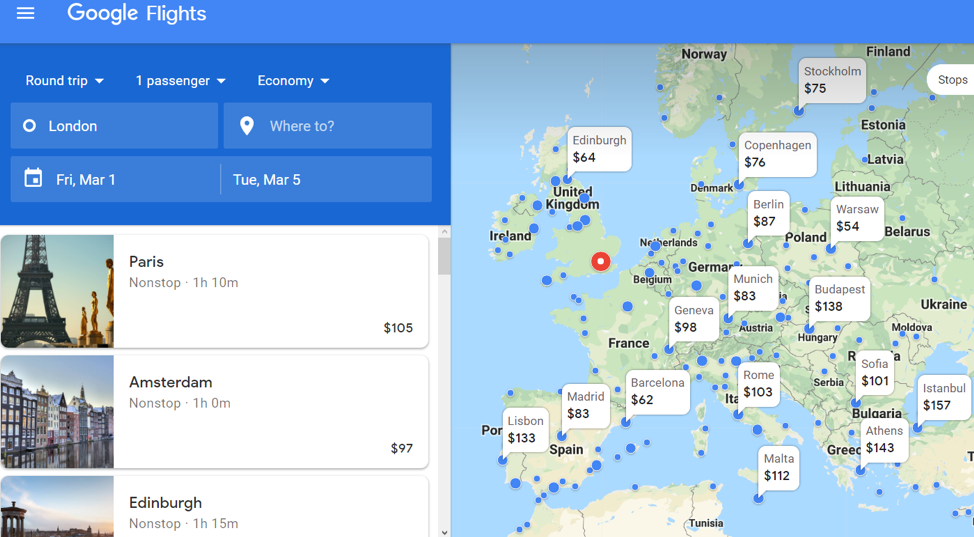
For instance, take the best flight purchase algorithm in the world Google Flights.

The United States Department of Justice Antitrust Division approved Google's $700 million purchase of ITA Software in 2011.

Within a few months, Google bent its algorithm into shape and reformulated it as Google Flights.

How does it stack up?

Easy to use, lack of digital ads, best of breed, and innovative are all ways I would describe this service.

That is why consumers prefer Google Flights over any other service.

It offers open-ended searches making the traditional flight search software seem pathetic.

Simply input the departure location and Google Flights will show the user every price to every location in the world on a visual map.

It’s travel transparency at its brightest and users can change trips in an instant if something attractive catches their eye.

The user can mix and match different destinations and dates until an optimal time and place can be calibrated along with a suitable price.

This gives the power back to the consumers.  

Once in a while, dispersion between the Google Flight price and the official airline site price can be irritating, but the accuracy has improved over time.

Truth be told, it’s a waste of time to use a different flight search engine now after the existence of Google Flights.

Google is able to do this because they are masters at building algorithms and have an army of engineers at their disposal.

Online flight brokers such as Expedia (EXPE) and TripAdvisor are on a collision course for the beast that is the Google algorithm division.

This dovetails astutely with my overarching theme of technology destroying every broker industry because FANG algorithm teams do a way better job enhancing this segment of business than anyone else.

As you correctly guessed, I am bearish Expedia and TripAdvisor long term.

Travel fare aggregators can’t compete with Google and former CEO of Expedia Dara Khosrowshahi was smart to take the head job at Uber saving him from the future carnage.


https://madhedgefundtrader.com/wp-content/uploads/2019/05/cropped-mad-hedge-logo-transparent-192x192_f9578834168ba24df3eb53916a12c882.png 0 0 Mad Hedge Fund Trader https://madhedgefundtrader.com/wp-content/uploads/2019/05/cropped-mad-hedge-logo-transparent-192x192_f9578834168ba24df3eb53916a12c882.png Mad Hedge Fund Trader2019-02-14 03:06:442019-02-14 03:05:58Facebook's New Problem
Page 2 of 212

tastytrade, Inc. (“tastytrade”) has entered into a Marketing Agreement with Mad Hedge Fund Trader (“Marketing Agent”) whereby tastytrade pays compensation to Marketing Agent to recommend tastytrade’s brokerage services. The existence of this Marketing Agreement should not be deemed as an endorsement or recommendation of Marketing Agent by tastytrade and/or any of its affiliated companies. Neither tastytrade nor any of its affiliated companies is responsible for the privacy practices of Marketing Agent or this website. tastytrade does not warrant the accuracy or content of the products or services offered by Marketing Agent or this website. Marketing Agent is independent and is not an affiliate of tastytrade. 

Legal Disclaimer

There is a very high degree of risk involved in trading. Past results are not indicative of future returns. MadHedgeFundTrader.com and all individuals affiliated with this site assume no responsibilities for your trading and investment results. The indicators, strategies, columns, articles and all other features are for educational purposes only and should not be construed as investment advice. Information for futures trading observations are obtained from sources believed to be reliable, but we do not warrant its completeness or accuracy, or warrant any results from the use of the information. Your use of the trading observations is entirely at your own risk and it is your sole responsibility to evaluate the accuracy, completeness and usefulness of the information. You must assess the risk of any trade with your broker and make your own independent decisions regarding any securities mentioned herein. Affiliates of MadHedgeFundTrader.com may have a position or effect transactions in the securities described herein (or options thereon) and/or otherwise employ trading strategies that may be consistent or inconsistent with the provided strategies.

Copyright © 2026. Mad Hedge Fund Trader. All Rights Reserved. support@madhedgefundtrader.com
Scroll to top